


Writing Style Guide: How to Choose, Build, and Actually Enforce One
A writing style guide is a documented set of rules that tells your team how to write. This guide covers which foundation guide to choose, the nine components ev
Updated 15 min read

A writing style guide is a documented set of rules that tells your team how to write. This guide covers which foundation guide to choose, the nine components ev
A writing style guide is a documented set of rules that tells everyone on your team how to write, not just what to write about. It governs voice, tone, grammar, punctuation, formatting, and terminology. Interest in how to build one hit an all-time peak in June 2026, driven largely by teams trying to govern AI-generated content at scale.
This guide covers which foundation guide to choose (AP, CMOS, Mailchimp, Google), the nine components every style guide needs, a 10-step build process, and the enforcement problem that quietly derails most guides after launch.
A writing style guide is a reference document that establishes consistent rules and preferences for anyone creating written content for an organization. It defines voice, tone, grammar standards, punctuation preferences, formatting conventions, approved terminology, and (for digital teams) accessibility and SEO guidelines.
It is distinct from two related but separate documents. A brand guide defines visual identity: logos, color palette, typography. An editorial policy governs what can be published and who approves it.
A writing style guide defines how the organization expresses itself in written form: the words, the punctuation, the point of view, the paragraph length.
There is a parallel distinction within the world of style documents themselves. A stylesheet is a per-document quick reference. A style guide is your team's documented standards.
A style manual is a comprehensive external authority, such as the Chicago Manual of Style or the AP Stylebook. These three terms are routinely conflated, including by teams that think they already have one.
Google Trends for "writing style guide" hit an index of 100 the week of June 6, 2026, a 7× surge from the June to July 2025 baseline of 7 to 16. The cause is structural: organizations generating written content at scale using AI tools now need style guides as a governance layer. Without one, AI output drifts toward plausible-sounding generic prose that sounds like every other brand.
Frontify on LinkedIn (June 2026): "The fix isn't just a better prompt; it's giving AI the brand knowledge it can actually understand and apply."
For teams that do not work with AI, the case is the same one it has always been. Style guides reduce editing cycles, accelerate freelancer onboarding, and prevent the voice shifts between pages that quietly undermine reader trust. For business writing contexts in particular, a documented standard is the difference between a persuasive proposal and a committee-edited one that reads like it was written by nobody.
The most consequential early decision in building a style guide is which established guide to use as your baseline.
Rather than documenting every grammar rule from scratch, most organizations select a well-maintained external guide and write their brand-specific exceptions on top. Carol Williams of WG Content: "Choosing an editorial style to follow, such as AP Stylebook or Chicago Manual of Style, helps keep the rules in your guide specific to your company. Be sure to call out any exceptions to the style you follow." (WG Content)
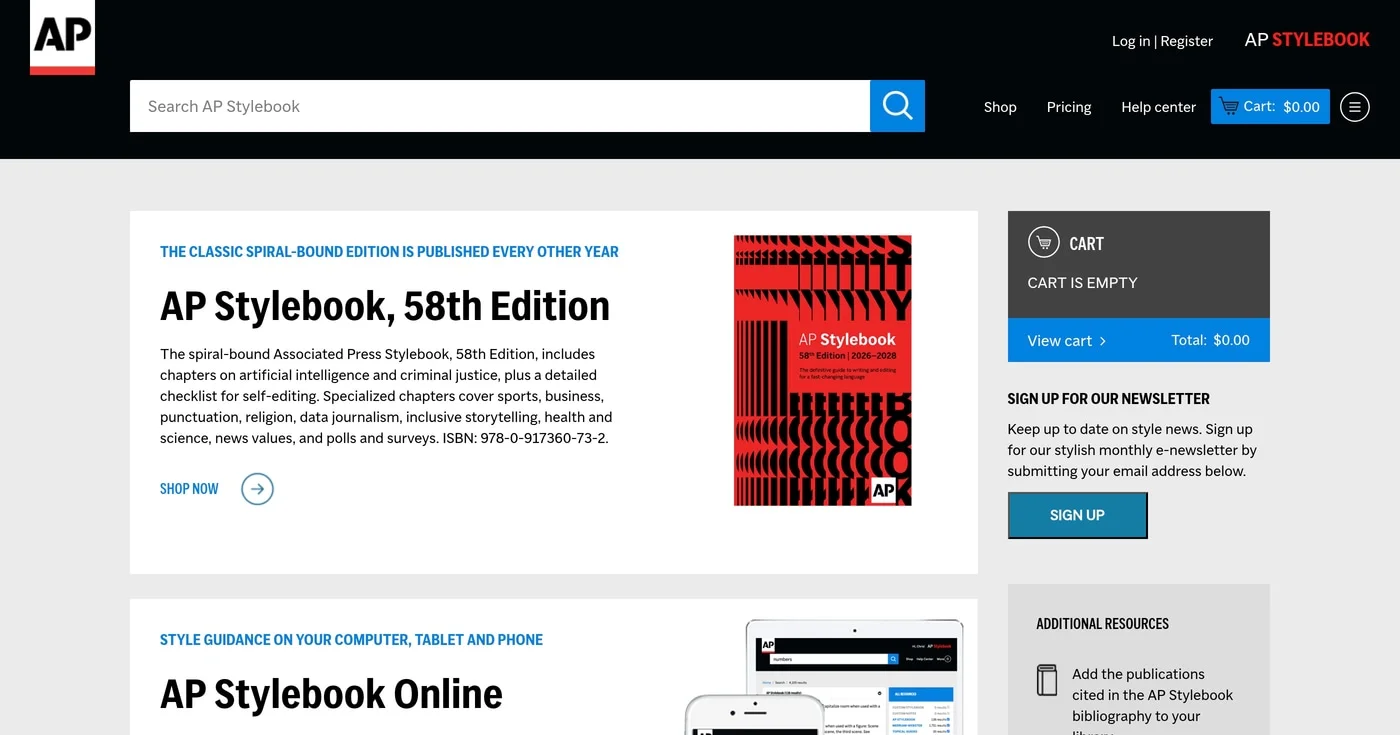
Here are the eight most widely used foundation guides and who each one serves:
Foundation Guide | Publisher | Best For | Key Differentiator |
|---|---|---|---|
Associated Press | Journalism, PR, public-facing marketing, news | No Oxford comma; inline source attribution; updated to its 58th edition; $31/user/year online | |
University of Chicago Press | Book publishing, long-form nonfiction, academic journals, white papers | Oxford comma; footnotes; 1.75 million+ copies sold; the US standard for fiction and nonfiction publishing | |
American Psychological Association | Social sciences, education, engineering, business | Self-described as "the world's most widely used"; 7th edition; strong inclusive and bias-free language framework | |
Modern Language Association | Academic humanities, literature, language arts | Nearly a century of use; citation-forward; MLA Handbook Plus digital platform | |
The Elements of Style (Strunk & White) | Longman/Pearson | Individual writers, quick general reference | Brevity and clarity as supreme virtues; 4th edition 2000; the most-cited general English writing guide |
Microsoft | Technology products, software documentation, general web content | Free; "warm and relaxed, crisp and clear"; bias-free communication; replaces the Microsoft Manual of Style | |
Developer documentation, APIs, technical writing | Free; conversational and second-person "you" by default; reference hierarchy model | ||
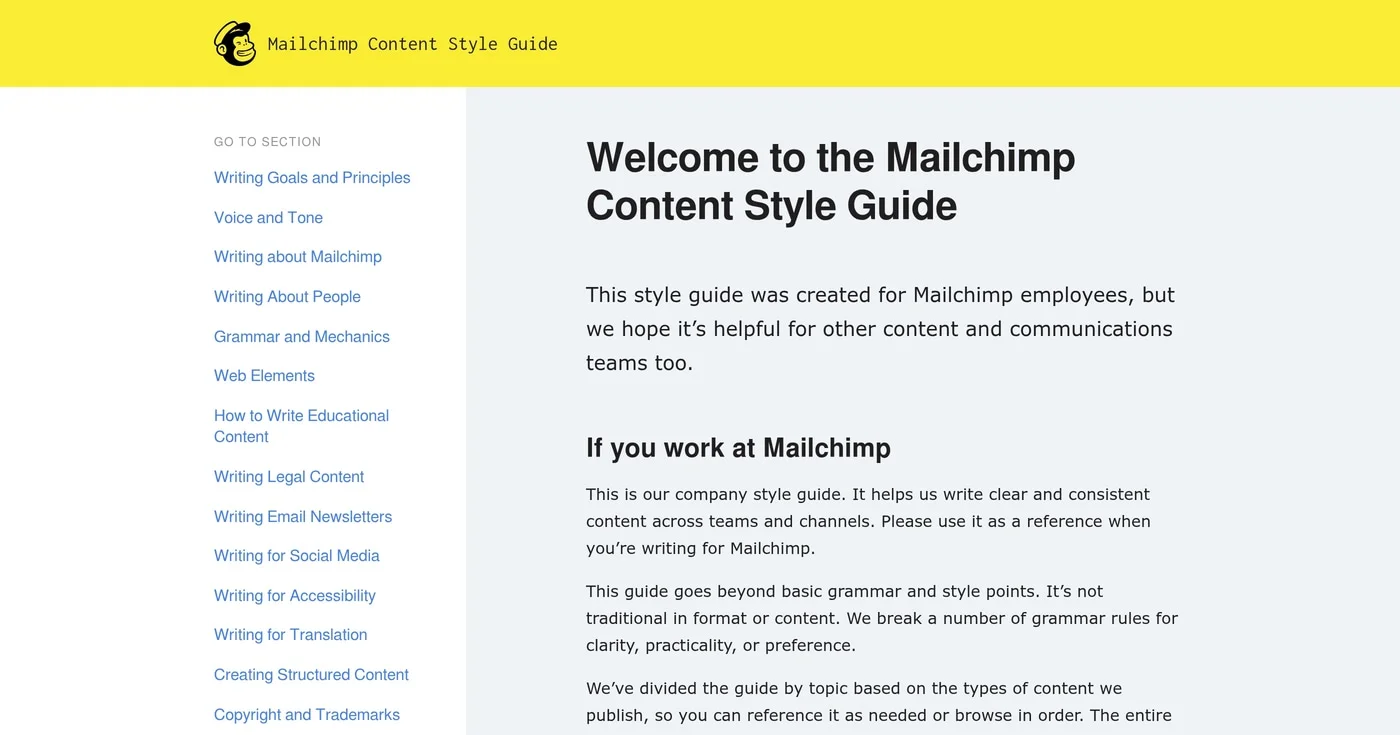
Mailchimp/Intuit | Brand and content teams, SaaS content, email | open source (CC BY-NC 4.0); TL;DR version available; breaks grammar rules deliberately for clarity |
Foundation style guides: what they cover and who uses them
To pick the right one, match your primary context:
Your Context | Recommended Foundation |
|---|---|
Journalism, PR, news, marketing | AP Stylebook |
Book publishing, long-form nonfiction | Chicago Manual of Style |
Academic humanities, literature | MLA Handbook |
Social sciences, psychology, education | APA Style |
Developer documentation, APIs | Google Developer Style Guide |
Technology products and software | Microsoft Writing Style Guide |
Content and brand teams | Mailchimp Content Style Guide |
Individual writers (quick reference) | The Elements of Style |
The routing is not purely by industry. A SaaS marketing team writing blog posts for technical audiences could reasonably use the Mailchimp guide as their brand layer while defaulting to Google Developer conventions for any code-adjacent content. What matters is that the choice is explicit and documented, so every exception your team makes is an intentional deviation from a shared baseline, not a gap.
Every writing style guide needs these nine components. Voice and tone comes first because it is the highest-impact component, and the most commonly reduced to an abstract trait list that changes no one's writing.
Voice is your organization's consistent personality. It does not change by channel or audience. Tone is how you express that voice in a specific context: more formal with an enterprise client, more conversational in a social caption.
The documentation method that changes writing behavior has four elements:
Kristine Sihto at WriteTheDocsAus: "Your writing choices affect the way a reader perceives you. Whether you use the serial comma, 'colour' vs. 'color,' or 'sympathize' vs. 'sympathise': all signal cultural sameness with your target audience."
One specific failure mode worth naming explicitly: "engineering formal" voice, where prose prioritizes the author's authority over the reader's comprehension. On r/technicalwriting, u/glittalogik described it as "tangled construction, hyperbolic mandates, and overuse of passive voice, where How To Do The Thing is clearly lower priority than The Author Is Very Smart And Important."
A style guide that does not explicitly prohibit this pattern will not prevent it.
Cover capitalization (headings, branded terms, product names, department titles), punctuation preferences (Oxford/serial comma decision, hyphenation, whether conjunctions start sentences), and abbreviation rules.
One section worth including right now: your house em-dash policy. AI detection tools are incorrectly flagging legitimate punctuation as a marker of AI-generated writing.
u/ReaverRiddle in r/freelanceWriters voiced the frustration: "It's maddening when people suggest that correct em-dash use signifies AI use. Maybe I'm just familiar with basic English punctuation conventions?" A documented house policy gives your writers the authority to push back.
For the most common grammar errors that style guides help prevent, see common grammar mistakes, especially comma usage, capitalization, and sentence structure, which account for most editorial inconsistencies in team-produced content.
Web writing requires deliberate formatting conventions because scanability drives comprehension. Document paragraph length (short, with white space between blocks), heading hierarchy (H1/H2/H3 and their semantic roles), and list conventions (bullets vs. numbered, how to introduce and close them). Also document emphasis rules: what qualifies for bold or italic, and caution against overuse.
Zapier's content team recommends including content-type templates for your most common formats (blog posts, emails, social captions, case studies) directly in your writing platform. That embeds the style guide as a starting point rather than a rule to look up. (Zapier)
Document your branded terms, preferred spellings, approved acronyms, and plain-language replacements for jargon. In regulated industries, this section carries legal weight: in healthcare, legal services, and financial services, word choice is a compliance matter, not just a style preference.
APA's 7th edition and Mailchimp's Content Style Guide are the model examples here. Cover alt text standards for images, descriptive link text (not "click here"), logical heading structure for screen reader support, and your position on inclusive language conventions. As accessibility requirements become legal obligations in more markets, this section is no longer optional for digital teams.
For teams publishing to the web, include keyword integration guidance (natural placement, not forced repetition), internal linking strategy, headline structure that reflects search intent, and metadata conventions. The test is whether optimization supports clarity rather than undercuts it.
End with a quick-reference checklist contributors can run through before publishing. Carol Williams of WG Content recommends a five-question pre-publish check:
The checklist removes the need for writers to hold the entire guide in working memory while drafting.
The freelance writing context makes the build process concrete: before you write a single word for a new client, both parties benefit from a documented style reference. At organizational scale, the same four stages apply.
Step 1: Audit existing content. Review your current website, blog, social, and marketing content for inconsistencies: voice shifts between pages, terminology discrepancies, formatting irregularities. Your guide should address real problems observed in real content, not hypothetical ones.
Step 2: Assess brand and goals. Describe your brand's core personality in three to five words. Who is your primary reader? What tone do you admire in other organizations' writing, and what tone actively bothers you?
Step 3: Choose a foundation guide. Use the routing table above. This is the most consequential single decision in the build. Documenting your brand-specific exceptions takes far less time when you start from a comprehensive baseline rather than a blank page.
Kristine Sihto: "Describing what you do is generally better than making a new set of rules, because in training and templating it costs less to implement." (WriteTheDocsAus)
Step 4: Define voice and tone. List personality traits, explain the constant-vs-contextual distinction, and provide side-by-side examples of correct and incorrect usage. Abstract trait lists do not change writing behavior. Concrete examples do.
Step 5: Build your glossary. Compile branded terms, preferred spellings, acceptable acronyms, and plain-language replacements for jargon. The smallest elements carry meaning: "healthcare" vs. "health care" is a branding decision with real consistency implications.
Step 6: Document grammar, punctuation, and formatting rules. Where your foundation guide already covers a rule, you only need to document your exceptions and edge cases. A sentence like "We follow AP style except: we use the Oxford comma, and we capitalize 'Team' when referring to our internal team" is a complete grammar entry.
Step 7: Add accessibility, SEO, and digital standards. Alt text requirements, link text conventions, reading level guidance, keyword integration, and metadata standards. These have moved from optional to expected for any digital-first publication.
Step 8: Create a writer checklist. A per-publication checklist converts the full guide into a pre-flight scan.
Step 9: Implement and distribute. Format options range from a Google Doc to a dedicated internal portal. The most effective delivery mechanism is embedding preferred formats as templates directly in the platforms your team already uses.
Aaron Orendorff at Zapier on what worked: "The only real success I've had is creating templates people use whenever they start any Google Doc or Slide. The key to consistently using a style guide is embedding it as usable templates directly within the platforms people use to create."
Step 10: Maintain and update. Assign a named owner, schedule annual reviews, and track recurring mistakes in real editing sessions so the guide improves based on actual patterns rather than anticipated ones.
WG Content's Carol Williams converted their guide into an internal custom GPT. "Now we can enter the question, 'How does WG Content format phone numbers?' and in seconds we've got our answer."
The guide becomes a queryable assistant instead of a document people have to remember to open.
Across Reddit, YouTube, LinkedIn, and technical writing communities, the dominant frustration is not "I don't have a style guide." It is "I have a style guide and nobody uses it."
u/Toadywentapleasuring in r/technicalwriting: "We have a 40 page style guide and it's the best I've seen. It's a combo of the best parts of AP, Chicago, AMA, and Microsoft with the other 40% customized for our needs. We all still complain about it and only about 2 out of 10 of us actually know it well enough to enforce it during editing." (score: 16)
The problem is structural. A style guide created in a document, uploaded to a shared drive, and mentioned once in onboarding has no mechanism of enforcement.
Contently on LinkedIn put it plainly: "A content manager hits the calendar. A managing editor decides what's worth publishing." (April 2026) Without someone in the managing editor role, the style guide has no owner.
The guide you have in a PDF and the guide your team actually uses are different objects. Building a style guide is the easy part. These five mechanisms close the gap.
Managing editor ownership. Someone whose job explicitly includes applying the style guide on every piece before it publishes, not just tracking the content calendar. Without this role, enforcement is everyone's job, which means it belongs to no one.
Onboarding integration. The style guide as a first-week resource, not a shared-drive artifact sent on day 60. Beth, a content design strategist at Intuit, named the dynamic directly: "Content is just the easiest target in the room from everybody. Everybody feels like they can write to a certain level." (Writer webinar) Establishing the guide during onboarding changes it from suggestions to standards.
Template embedding. Preferred document formats embedded directly in Google Docs or Slides so the style guide is the path of least resistance. Writers start with the structure, not a blank page that invites deviation.
AI-assisted querying. Loading the style guide into an internal custom GPT converts it from a reference document into a conversational assistant. The question "how does our guide handle title capitalization in email subject lines?" gets answered in seconds instead of requiring a search through a PDF.
Stakeholder co-creation. Ask people what they need before the guide is written. Kristine Sihto at WriteTheDocsAus found that early involvement builds "signal repeaters": "The more involvement people have at the earliest stages, the more uptake later." People enforce what they helped build.
The serial comma illustrates the stakes at the extreme end. At a WriteTheDocsAus talk, Kristine Sihto cited contract disputes settled by a missing serial comma. It is not a stylistic nicety; it is a legal clarity instrument.
A team that cannot agree whether their house style uses it has not actually enforced their style guide.
These are the most-cited publicly available style guides. All are free unless noted.
Organization | Guide Focus | Access | Notable Element |
|---|---|---|---|
Brand voice + tone | Free (CC BY-NC 4.0) | TL;DR version; person-first language; breaks grammar rules for clarity | |
Developer docs | Free | Conversational tone; second-person "you"; continuously updated | |
Tech/general content | Free | "Make every word matter"; bias-free communication guide | |
Design system | Free | Inclusive writing; documentation and conversational patterns | |
Developer docs | Free | Documentation methodology, directory organization, content architecture | |
Developer docs | Free | Inclusive language; accessibility and screen reader guidance | |
Government content | Free | Plain language mandate across all gov.uk content | |
Government content | Free | Bilingual English/French; accessibility and plain language focus | |
Product documentation | Developer login | 500+ pages; detailed product nomenclature and history-of-changes log | |
Shopify | Partner/merchant content | Limited | Best-in-class grammar do/don't format per multiple sources |
Publicly available writing style guides worth studying
u/Possibly-deranged on r/technicalwriting (score: 48): "The Microsoft style guide is kind of the bible of technical writing … Google's is good … same with Apple's … Red Hat's is another."
The pattern that distinguishes the most-referenced guides: they show exactly what the wrong version looks like alongside the correct one. Shopify's grammar section was called out by Zapier specifically because "nothing is unclear": every rule comes with a counterexample. Abstract rules alone do not change behavior.
Zapier's content team recommends three to five pages of essentials as the practical sweet spot. Kristine Sihto at WriteTheDocsAus: "A style guide should be as long as it needs to be, and as short as possible. Too long and nobody will read it."
A 40-page guide may be technically complete and practically useless.
Listing adjectives like "professional, approachable, and clear" describes nearly every organization's aspirations. Side-by-side do/don't examples show what those adjectives actually mean when applied to a sentence. Without examples, the trait list functions as aspiration, not instruction.
The writers and editors who live with the guide every day should be involved before it is finalized. Their questions surface the ambiguities the document needs to resolve.
Their co-ownership is what makes enforcement possible later. A guide that lands as a mandate has a different adoption curve than one that incorporates feedback from the team.
Alt text requirements, descriptive link conventions, and logical heading structure belong in the initial build, not in a future revision. As accessibility obligations expand into more markets and more platforms, these are operational requirements, not optional polish.
Not assigning a review owner is the most common long-term failure. Zapier: "The biggest mistake companies make is assuming style guides are a one-and-done deal. In reality, your style guide needs to be updated based on changes in your messaging, the product's UI, and branding transformations."
A guide last updated three years ago is not a style guide; it is a historical document.
Documenting an original rule for every grammar edge case wastes time that the AP Stylebook, Chicago Manual of Style, or Google Developer Style Guide has already spent. Choose a foundation, then document exceptions. Your team's energy should go into the brand-specific layer, not into reinventing universal grammar conventions.

Spot passive voice with the be-plus-participle test. Keep it for unknown actors, then rewrite only when the missing agent is the point of the sentence.
Epistolary fiction is told through letters, diaries, and found documents. Nested origins, seven examples, and where the form breaks.

Free verse is open-form poetry with no prescribed meter or rhyme scheme. The line, cadence, and sound do the work meter used to do.
Professional publishing supported by generous companies you should check out.


