


Freelance Writing: A Field-Tested Playbook for Getting Paid
A practical guide to starting and growing a freelance writing career. Covers niches, rates, portfolio building, client acquisition, tools, and common mistakes.
Updated 14 min read


A practical guide to starting and growing a freelance writing career. Covers niches, rates, portfolio building, client acquisition, tools, and common mistakes.
Freelance writing is a career where you get paid to produce written content for clients, publications, or companies, without being employed by them full-time. The freelance writing market is worth $7.6 billion in 2025, growing at 8.1% annually. 42% of freelance writers earn up to $5,000 per month, according to a 2025 survey of 530 writers.
Most beginners undercharge and over-research. You'll find practical rate benchmarks, client acquisition strategies, and the tools you actually need.
This guide covers everything you need to know about freelance writing, from building your first portfolio to scaling past full-time income.
Freelance writing is contract-based writing work: you produce content for a client, deliver it, and get paid. Unlike a staff writer role, you set your own hours, choose your clients, and negotiate your rates independently.
The category is broad. Freelance writers produce blog posts, white papers, email newsletters, case studies, landing pages, technical documentation, magazine features, and ghostwritten books. The format and industry you specialize in largely determine what you earn.
Companies need words to sell products, retain customers, and rank on Google. In industries where those words carry high commercial value (finance, SaaS, healthcare, B2B tech), the writing rates reflect that.
Ghostwriting and white papers are two of the highest-paying freelance writing formats, with top writers earning $10,000 or more per month. Grant writing and legal writing similarly pay well because of the technical barrier and the stakes involved.
The writer who understands both the craft and the client's business context earns significantly more than the writer who only focuses on prose.
AI content tools have changed volume economics but haven't replaced skilled writers. 59.6% of freelance writers report insufficient earnings as a challenge, but 52% of writers earned the same or more in 2025 compared to 2024.
The writers losing ground are those producing generic commodity content at low rates. The writers gaining ground specialize, develop subject matter expertise, and position themselves as editors and strategists, not just producers.
Freelance writing operates like any service business: you acquire clients, deliver work, invoice, and repeat. The key variable is how you structure those client relationships.
A client hires you to write a specific piece: one white paper, one landing page, one case study. You agree on scope, deadline, and fee. Payment is typically 50% upfront, 50% on delivery.
Project work is common for new clients and one-time engagements. The downside is income variability. You're always looking for the next project.
A retainer means a client pays a fixed monthly fee for a set volume of work. Four blog posts per month at $350 each, billed on the first of every month.
Retainers are the most stable freelance arrangement. They make budgeting easier and reduce marketing time. Three or four solid retainer clients can produce a full-time income.
Experience | Rate Per Word | Rate Per Article | Hourly Rate |
|---|---|---|---|
Beginner | $0.02–$0.05 | $50–$150 | $15–$30 |
Intermediate | $0.10–$0.20 | $150–$500 | $50–$75 |
Experienced (niche) | $0.35–$1.00+ | $500–$2,000 | $100–$250+ |
Expert (white papers/ghostwriting) | $1.00–$2.00+ | $2,000–$10,000+ | $150–$300+ |
Sources: EFA Rate Chart, jasper.ai
Most clients use bank transfer, PayPal, or a platform like Bonsai that handles contracts and invoicing in one place. If you're on Upwork, payments run through the platform's escrow system.
Always send a written agreement before starting work. Even one paragraph confirming scope, rate, and deadline protects both sides.
Generalist writers compete on price. Specialist writers compete on expertise. The niche you choose determines your earning ceiling more than your skill level in the short term.
Finance and personal finance pays well because the content is regulated, complexity is high, and readers make financial decisions based on what they read. You don't need a finance degree, but you do need to understand the fundamentals and write accurately.
SaaS and B2B technology is the most in-demand niche for content marketers. Digital marketing and SaaS/tech were the top two niches in the 2025 freelance writing survey. Companies with monthly marketing budgets in the six figures are always buying content.
Ghostwriting and white papers offer the highest per-project fees. White papers and reports command premium rates because they require original research, structured argumentation, and are used in sales cycles with real revenue attached.
Emerging niches for 2026 include AI governance and RegTech, cybersecurity, and B2B fintech infrastructure, according to industry observers. These niches are underserved because few writers have the domain knowledge.
Grant writing provides consistent work from nonprofits, research institutions, and government-funded organizations. The work is repetitive but the pay is reliable.
Pick based on two filters: what you can learn convincingly, and what clients pay for. You don't need existing expertise. You need enough interest to research deeply and communicate clearly.
A flexible starting point: SaaS content writing. There's consistent demand, the learning curve is manageable, and rates are competitive. You can narrow to a specific category (HR tech, fintech, DevTools) as you build experience.
Your portfolio is the only thing that gets you hired before you have a track record. Here is what a strong entry-level portfolio looks like and how to build one without existing clients.
Three pieces is enough to start. Each should demonstrate writing in your target niche, at the length and format your target clients actually publish.
If you want to write SaaS blog posts, your three samples should be SaaS blog posts: around 1,200–2,000 words, optimized for search, with a clear structure. Not your college essays. Not poetry.
LinkedIn Articles: Publish directly on LinkedIn. Potential clients can see your samples without clicking away to an external site.
Medium: A free platform with a built-in audience. A well-written piece on Medium builds credibility and occasionally generates inbound interest.
Guest posts: Email editors of niche blogs in your target industry and offer a free article in exchange for a byline. Many accept because they need content.
Spec work: Write a mock article as if you were writing for a specific publication or client. Label it clearly as a sample. This is standard practice at the entry level.
Journo Portfolio and Contently are two platforms built for displaying writing clips professionally. Both have free tiers.
Don't include articles from unrelated niches unless they demonstrate an exceptional skill. A finance writer with three strong fintech articles will win the pitch over a generalist with fifteen mediocre posts from five different industries.
Don't host samples on Google Drive and share the link. Use a dedicated portfolio site or platform. Drive links expire, require permissions, and look unprofessional.
The single most common reason new writers stagnate: they write but don't market. Marketing is at least 30% of your job as a freelance writer, especially in the first 12 months.
Cold pitching means sending an unsolicited but targeted email to a potential client or editor. Most writers avoid it because of rejection. Most writers who do it consistently land clients within 90 days.
An effective cold pitch has three parts: a specific compliment about their content, a brief statement of your relevant experience, and a concrete offer. That offer should be a specific article idea or a request for a discovery call.
Keep it under 200 words. One clear ask. No attachments.
Upwork currently lists over 2,500 open freelance writing jobs. The platform takes 20% on early earnings from each client, dropping to 10% after $500 billed to that client.
Other reliable boards: ProBlogger Job Board, We Work Remotely, and Contena. Job boards are higher-effort and lower-margin than cold pitching but provide immediate leads when you're starting out.
LinkedIn is the single best platform for B2B freelance writers. Optimize your headline with your niche (e.g., "B2B SaaS Content Writer | Blog Posts, Case Studies, White Papers"). Post one piece of content per week and connect with content managers, heads of marketing, and founders in your target industry.
Inbound leads from a well-optimized LinkedIn profile cost zero additional effort once the profile is live.
Your best client is a client who refers another client. At the end of every project, ask directly: "Do you know anyone else who might benefit from this kind of content?" Most satisfied clients are happy to refer. Most freelancers never ask.
Content agencies hire freelance writers on a contractor basis. The rates are lower (often $0.05–$0.15/word), but the volume is consistent and you don't handle sales. Working with agencies early builds experience and can fill slow months.
48.6% of freelance writers earn under $2,000/month. A contributing factor: most writers set rates by guessing or copying other beginners rather than benchmarking against actual market data.
Calculate your target monthly income and divide it by your billable hours. The result is your minimum hourly rate: if you want $5,000 per month and work 80 billable hours, your floor is $62.50/hour.
Then benchmark against published data. The EFA 2026 Rate Chart is the most comprehensive publicly available survey of editorial rates, based on data from November 2025 through January 2026.
Raise your rates when you're fully booked and turning down work. Raise them when a new client inquires, not mid-contract with an existing one. Raise them by 15–25% at a time, not incrementally.
Publications paying $500 or more per article exist across categories. Some print magazines pay $1.00/word for assignments and $0.50/word for online pieces. These are just clients you haven't pitched yet.
Model | Best For | Downside |
|---|---|---|
Per word | Blog posts, articles | Penalizes fast writers |
Per project | White papers, long-form guides | Requires accurate scoping |
Hourly | Research-heavy projects, editing | Clients can resist not knowing the final cost |
Retainer | Ongoing blog content, newsletters | Requires established client trust |
You don't need a sophisticated tech stack to run a freelance writing business. Most successful writers use four to six tools total.
Tool | Category | Cost | Why It Matters |
|---|---|---|---|
Writing | Free | Universal client compatibility, comments, version history | |
Proofreading | $12–$30/mo | Catches grammar errors before client delivery | |
Readability | Free/one-time | Flags passive voice, complex sentences, adverb overuse | |
Contracts & Invoicing | From $17/mo | Contracts, invoicing, payment tracking in one place | |
Invoicing | Free | Invoicing and basic accounting at no cost | |
Portfolio | Free | Professional clip hosting; clients use it to discover writers | |
Project Management | Free tier | Track deadlines, client notes, pitches | |
All-in-One | From $19/mo | Editorial calendars, invoicing, client portals |
Source: Plutio tools comparison
You don't need a professional website immediately. A LinkedIn profile and a Contently or Journo Portfolio page are enough to land your first clients. Build the website when you have the budget and the clarity to know what you want it to say.
You don't need expensive writing software like Scrivener for client work. Save it for long-form personal projects.
Most writers don't go full-time overnight. The typical path moves through three recognizable phases.
Phase 1: Building samples (months 1–3). You're writing for exposure, experience, or very low pay. The goal is a portfolio, not income. This phase ends when you have three to five strong clips in a defined niche.
Phase 2: Finding your first real clients (months 3–12). You're actively pitching, following up, and building a small client roster. Income is inconsistent: one retainer, a few one-off projects, no guarantee of more. Most writers who quit do so here because they expect income before building the infrastructure for it.
Phase 3: Systematizing (months 12–24+). You have enough client relationships to generate referrals and start turning down low-paying work. You raise your rates. Retainers replace most project work and income stabilizes.
The writers who compress Phase 2 have two things in common: they pick a niche early and they market consistently. Both are decisions, not circumstances.
Three to four hours per week, every week, regardless of how busy you are. That block should include at least five cold pitches, one LinkedIn post, and responses to any inbound interest.
Five cold pitches per week equals 260 per year. At a 5% conversion rate, that's 13 new clients annually. Most won't become long-term retainers, but three to four will.
The math on freelance writing is simple. The execution is where most writers stop.
78% of freelance writers charge 40% below market rate, according to 2026 data. This happens because most writers set rates based on what they feel comfortable charging, not what the market supports.
Benchmark against the EFA Rate Chart, published industry surveys, and the rates listed in job postings. When you see what comparable writers charge, you'll know whether your current rates are competitive.
Editors and content managers receive dozens of pitches per week. A single email is easy to miss. Following up once, about a week after the original pitch, is professional and often doubles your response rate.
Most writers send one pitch and move on. Following up costs three minutes and often makes the difference between a yes and silence.
The feast-or-famine cycle is real and almost entirely self-inflicted. Writers who market only when they need work end up in a cycle where every slow period becomes a crisis.
Protect two to four hours per week for marketing activity (pitching, LinkedIn posting, outreach), even when you're fully booked. The clients you reach today will become the retainers that stabilize your income in three months.
Generalists compete on price. A writer who covers "any topic" sends an implicit signal that they're not expert in anything. Clients with real budgets look for subject matter depth, not breadth.
Picking a niche doesn't mean you can never write outside it. It means you lead with one specialty that makes you memorable and referable.
Writing is 60–70% of the job when you're starting out. The rest is pitching, invoicing, managing client relationships, revising, and tracking your business. Writers who focus only on craft and ignore the business side underperform financially even when their writing is excellent.
Beyond cold pitching and LinkedIn, several platforms serve as reliable pipelines for work at different career stages.
Upwork is the largest general freelance marketplace. Competition is high, but over 2,500 writing jobs are listed at any given time. The platform's escrow system protects payment, which matters when working with new clients.
Contently operates as both a portfolio platform and a talent network. Brands use it to find vetted writers. Creating a strong Contently profile is worth the time even if you never apply for work through it, because some clients discover writers there passively.
ProBlogger Job Board lists blog writing opportunities from companies actively looking for content writers. Rates vary widely, but the board skews toward content marketing roles rather than content mill work.
Contra is a newer platform positioned for independent professionals. It charges no platform fee (unlike Upwork's 20%), which means more take-home on every project.
Moxie combines CRM, invoicing, and project management in a single tool designed for freelancers. It's not primarily a job board, but it has a client directory and community that generates leads.
Don't try to be active on all platforms at once. Pick one marketplace and one portfolio platform. Optimize both well before adding more.

Gray is American English; grey is British and Commonwealth. Same color, same sound. Freeze titles, match your variety, then use the locked-name table.

Get paid to read books only when you deliver a review, critique, QC pass, or narration hour. Seven gigs, first-party rates, Foreword $55 and Booklist $15.
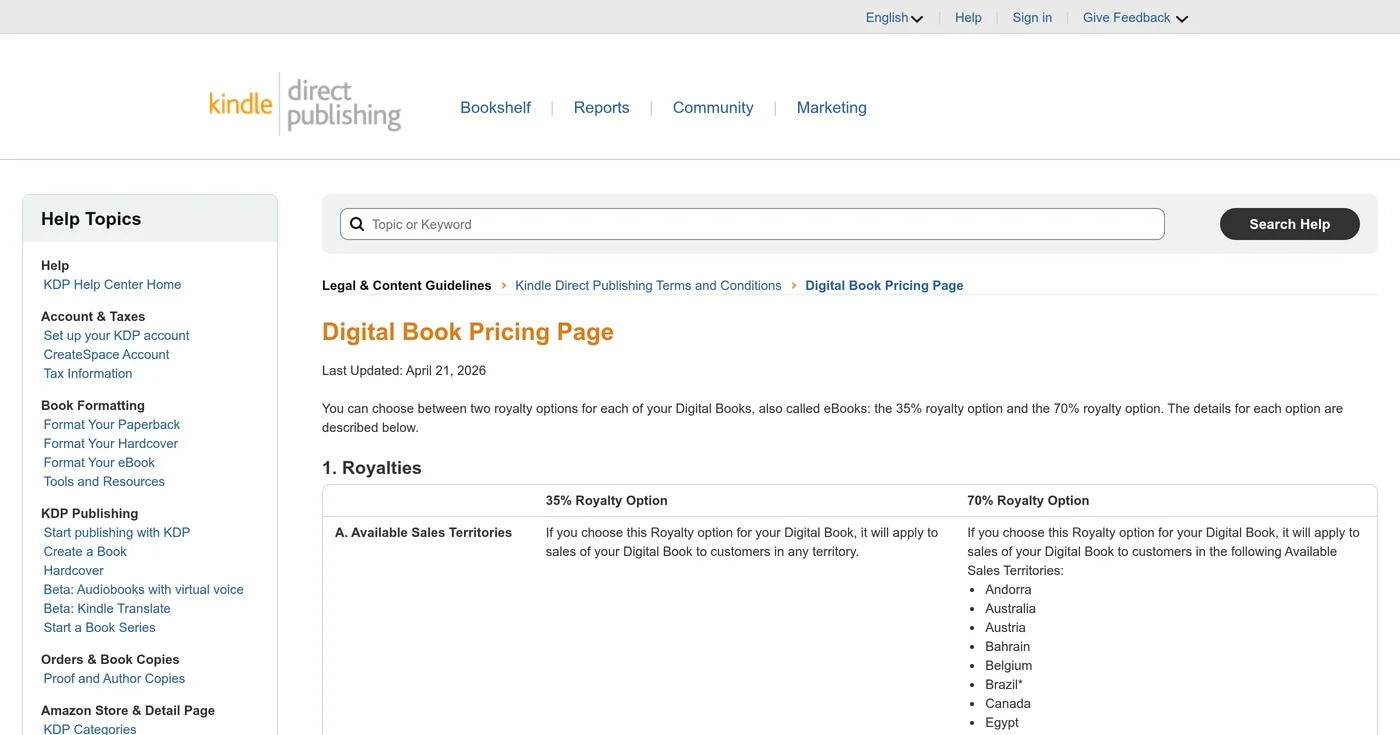
Amazon KDP royalties explained: the 35% vs 70% tier rules, the $12.99 ceiling change, delivery fees, paperback math, and Kindle Unlimited page-read rates.
Professional publishing supported by generous companies you should check out.


