


Newsletters: A Working Playbook for Writers
Newsletters give writers a direct, algorithm-proof line to readers. Learn how to start, grow, and monetize yours with data from 65,000+ newsletter creators.
Updated 13 min read

Newsletters give writers a direct, algorithm-proof line to readers. Learn how to start, grow, and monetize yours with data from 65,000+ newsletter creators.
A newsletter is an email-based publication you send on a regular schedule to a list of subscribers you own outright. Unlike social media, there is no algorithm deciding who sees your work.
beehiiv's platform alone reached 255 million unique readers in 2025, processing 28 billion emails sent by 65,000+ newsletters. Substack crossed 5 million paid subscriptions by March 2025. Email consistently delivers $36–$42 in revenue for every dollar spent, outperforming every other digital channel.
This guide covers everything from choosing a platform to writing your first issue, growing a loyal list, and monetizing it, for writers who want a direct, lasting line to readers.
A newsletter is a regularly published email sent to a list of people who opted in to receive it. It can carry original writing, curated links, news digests, tutorials, or any combination, delivered directly to a subscriber's inbox.
The format has existed since the print era; email newsletters emerged in the 1990s with early consumer internet access. Substack launched in 2017 and changed the model by making paid creator newsletters mainstream. The global daily newsletters market was projected to reach $16.08 billion in 2025 and is expected to grow to $27.08 billion by 2035.
What separates a newsletter from every other content channel is ownership. Instagram's organic reach averages around 3–5% of followers; Facebook Pages reach around 1–2%.
Your newsletter list is yours. When you move platforms, your subscribers come with you.
Readers who subscribe to your newsletter have done something deliberate: they gave you their email address. That act signals a different quality of attention than a follow or a like.
99% of email users check their inbox every day. 40% of people check email before 6 a.m., before opening social apps or checking the news. Writers who build a newsletter build a distribution channel that works while they are writing, sleeping, or between books.
The numbers support this. beehiiv's 2026 report found platform-wide open rates averaged 41%+ in 2025. MailerLite's benchmark study of 3.6 million campaigns put the 2025 average at 43.46%.
Arts and writing newsletters historically perform above general marketing averages. Compare that to social algorithms, which routinely cap organic reach at single-digit percentages even for large followings.
The most common early mistake is trying to appeal to everyone. Jason Feifer of One Thing Better launched two newsletters that failed before narrowing to a hyper-specific premise: one actionable thing per week to be happier or more successful at work. That focus built a loyal, engaged list.
Ask two questions before you write a word: who is underserved in this topic, and what will readers know or be able to do after each issue? Specificity is your competitive advantage, not your limitation.
Your platform determines your monetization options, your analytics access, and how much of your revenue you keep. The four dominant platforms for writers are Substack (built-in discovery and paid subscriptions), beehiiv (advertising network and growth tools), Kit (automation and commerce), and Ghost (blogging-plus-newsletter with full independence).
See the full breakdown in the newsletter platforms guide on Best Writing, which covers features, pricing, and the right fit by use case.
A landing page and a lead magnet are the minimum viable funnel. The landing page should name your audience, your topic, and your cadence in two sentences. The lead magnet (a sample issue, a free resource, a short guide) gives a new visitor a reason to subscribe today rather than later.
If monetization is a near-term goal, some writers launch with a starter paid tier immediately to attract subscribers who have already decided they are willing to pay.
Weekly is the most common and effective cadence for writers. Predictability beats frequency: beehiiv's 2025 data shows only 15.82% of creators publish daily, up from 4.9% in 2023, a pipeline most solo writers cannot sustain at quality. As Jason Feifer advises: "Be incredibly, unwaveringly predictable in serving them."
Draft your first three issues before you launch. Having a buffer reduces anxiety and lets you focus on distribution at launch instead of also writing on deadline.
A welcome sequence is a short automated series of emails triggered when someone subscribes. Welcome emails average 68.6% open rates, among the highest of any email type. A well-structured welcome series consistently outperforms a single welcome message on both engagement and revenue conversion.
Use the welcome sequence to set expectations, deliver your lead magnet, share your best prior writing, and start a conversation by asking one direct question.
Not all newsletters follow the same format. Here are the seven most common structures for writer-led publications:
Type | Format | Best For |
|---|---|---|
Author/Personal | Voice-driven updates, behind-the-scenes, reader exclusives | Fiction and nonfiction authors building a direct fanbase |
Opinion/Creator | Essays, commentary, hot takes | Writers with a distinct, recurring point of view |
Industry Digest | Curated summaries, news roundups | Writers covering a specific professional niche |
Curated/Resource | High-value links, tools, and reading recommendations | Researchers, educators, subject-matter experts |
Tutorial/How-to | Step-by-step instruction on a craft or process | Writing coaches, teachers, skill-builders |
Community/Membership | Gated posts, discussions, reader events | Writers with an engaged existing audience |
Roundup/Digest | Aggregated niche news, brief summaries | High-frequency, scalable publishing format |
HubSpot's 2025 survey found that newsletters featuring personal opinions and hot takes generate the highest open, click, and conversion rates. The format where a writer's voice is most visible tends to outperform curation-only formats when it comes to reader loyalty.
The most effective early growth lever, per HubSpot's survey of 400+ newsletter operators, is word-of-mouth and direct subscriber recommendations, cited by 42% of operators as their top strategy. You cannot manufacture this; you earn it by consistently delivering something worth sharing.
Practical tactics that compound over time:
Referral programs automate the word-of-mouth loop. Morning Brew scaled to 4 million+ subscribers by July 2025 using a structured referral system where existing readers earned rewards for successful referrals.
List size is less important than list engagement. A 20,000-subscriber list with 30% engagement outperforms a 100,000-subscriber list at 5%. Regular list hygiene (removing inactive subscribers, monitoring bounce rates, authenticating your sending domain with SPF, DKIM, and DMARC) keeps your deliverability healthy and your engagement metrics meaningful.
Subject lines with 20 or fewer characters achieve a 37.6% open rate in benchmark studies. Personalized subject lines generate 50% higher open rates. A subject line should reflect the most valuable piece of content in the issue, not attempt to summarize everything at once.
Timing matters, too. Midweek sends (Tuesday through Thursday) and late morning (10–11 am local time) outperform Monday morning and Friday afternoon. For B2B-adjacent writing newsletters, Tuesday and Thursday are the highest-performing days.
Open rates are less reliable since Apple's Mail Privacy Protection pre-fetches emails, recording an "open" even when the reader has not read a word. The pre-MPP industry average was around 21.5%; post-MPP averages jumped to 43–49%, measuring something different.
Focus on click rates instead. MailerLite's 2025 benchmark puts average click rates at 2.09%. A newsletter with consistent 3–5% click rates is performing well.
Replies are the highest-signal metric of all: a reader who replies has shifted from consumer to participant.
Kevin Alexander of Inbox Collective frames newsletters as a two-way medium, not a broadcast. Ask questions at the end of each issue and respond to replies. Acknowledge when readers share what they are struggling with or what worked.
HubSpot's data confirms this: opinion-led, personality-driven newsletters outperform informational formats on every engagement metric. The more distinctly yours the voice, the more irreplaceable the newsletter.
Build for at least 90 days before introducing monetization. The median creator on beehiiv reaches first-dollar revenue within 66 days of launch. Amy Porterfield frames the principle well: "The success of your launch is directly related to how you show up when you're not launching."
The five most common monetization models for writers:
Paid subscriptions. Recurring revenue from monthly or annual tiers. Substack takes 10% of paid subscription revenue; beehiiv and Ghost keep more for the creator.
Substack crossed 5 million paid subscriptions in March 2025. beehiiv generated $19 million in paid subscription revenue in 2025, a 138% increase from 2024.
Sponsorships. Business newsletters command CPMs of £25–£80 per 1,000 opens. Sponsorships are the fastest path to early revenue because they do not require a paid subscriber base, only an engaged one. Many writers start here and layer in paid subscriptions once their audience understands the value of exclusive content.
Affiliate marketing. Recommending products and tools relevant to your readers in exchange for commissions. Low friction to start; scales with list size and the trust you have built.
Digital products. Ebooks, courses, templates, or premium research reports sold directly to your list. The newsletter is the distribution channel; the product is the offer.
Services and consulting. The newsletter as a lead-generation engine for higher-value work: editing, coaching, workshops, speaking. Writers who build authoritative newsletters in a niche find that clients come to them rather than the reverse.
Pew Research (February 2026) found 7% of U.S. adults paid for or donated to a news-focused newsletter in the past year. The behavior is growing, but not yet mainstream. The window for building a paid subscriber base before the market matures is now.
See the full comparison in the newsletter platforms guide, which covers features, pricing, and the right fit by use case in depth.
Platform | Best For | Pricing | Free Plan |
|---|---|---|---|
Discovery, paid subscriptions | Free; 10% of paid revenue | Yes | |
Audience growth, ad network | Free up to 2,500 subs; from ~$42/mo | Yes | |
Automation, digital commerce | Free up to 10,000 subs; from $39/mo | Yes | |
Independence, blogging + newsletter | From $18/mo (1,000 members) | No (open-source self-host) | |
Budget-conscious beginners | Free up to 1,000 subs; from $9/mo | Yes | |
Simplicity, low cost | Free up to 2,500 subs; from $9/mo | Yes |
InboxReads' 2025 survey identifies Substack and beehiiv as the dominant platforms, with Substack holding steady market share and beehiiv showing consistent growth.
If monetization through paid tiers is your primary goal, Substack's discovery engine gives you a head start. If you want to grow an advertising-supported newsletter with performance analytics, beehiiv offers more built-in tools.
"A newsletter for everyone" is a newsletter for no one. Jason Feifer launched two newsletters that failed to gain traction before finding success with One Thing Better's narrow, specific premise. Your niche should feel uncomfortably specific at first; that discomfort is the sign you have found the right focus.
Inconsistency erodes the habit you are trying to form in your reader. Subscribers who do not hear from you for three weeks will forget why they subscribed. If life intervenes, a brief "taking a week off" note to your list maintains trust better than silence.
Rushing to launch a paid tier before you understand what readers value leads to low conversion rates and damaged trust. Use your first 90 days to identify which issues generate the most replies, clicks, and forwards. That feedback tells you what people will pay for.
Writers who come from social media or traditional publishing import a broadcast mindset by default. Newsletters are a two-way medium: the goal, as Kevin Alexander puts it, is dialogue, not monologue. Ask questions, respond to replies, and acknowledge readers by name when they share something useful.
Since Apple Mail Privacy Protection launched, open rates are an inflated metric. A jump from 25% to 50% open rate may reflect nothing about actual reader behavior. Track clicks per issue, reply rates, and subscriber growth instead: these metrics reflect real engagement, not pre-fetched email loads.
Geoff Sharpe of Lookout Media identifies deliverability as the most underestimated technical factor for new newsletters. Failing to authenticate your sending domain with SPF, DKIM, and DMARC records means your emails can land in spam regardless of writing quality. Set up authentication before you send to a list larger than 100.
Jason Feifer is editor-in-chief of Entrepreneur magazine and host of the Problem Solvers podcast. He launched One Thing Better on beehiiv after two earlier newsletter attempts failed to build an audience.
The lesson from those two attempts: he was trying to be too many things to too many people. One Thing Better's premise is a single, actionable insight per week: one thing to be happier or more successful at work. That constraint forces every issue to deliver a complete idea rather than a collection of loosely related observations.
Feifer describes consistency as a form of trust-building: showing up reliably plants the idea in readers' minds that you are dependable. The newsletter grew because each issue was self-contained, shareable, and immediately useful. Read it once and it worked; subscribe and it kept working.
The practical takeaway: specificity of premise plus consistency of delivery outperforms any distribution hack.

Gray is American English; grey is British and Commonwealth. Same color, same sound. Freeze titles, match your variety, then use the locked-name table.

Get paid to read books only when you deliver a review, critique, QC pass, or narration hour. Seven gigs, first-party rates, Foreword $55 and Booklist $15.
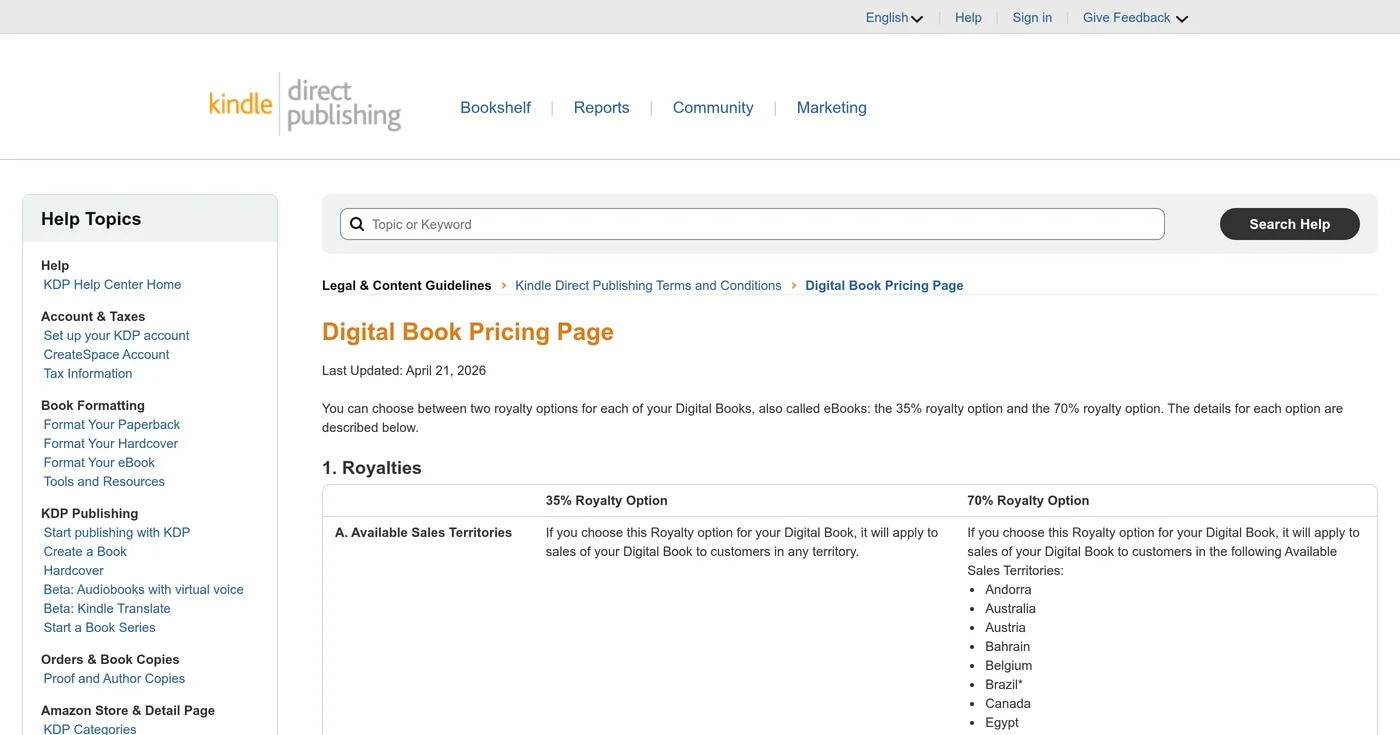
Amazon KDP royalties explained: the 35% vs 70% tier rules, the $12.99 ceiling change, delivery fees, paperback math, and Kindle Unlimited page-read rates.
Professional publishing supported by generous companies you should check out.


