


Sentence Variety: Definition, Techniques, and Before-and-After Examples
Learn what sentence variety is, why it matters for reader engagement, and how to use length, structure, and opening patterns to fix monotonous prose.
Updated 17 min read

Learn what sentence variety is, why it matters for reader engagement, and how to use length, structure, and opening patterns to fix monotonous prose.
Sentence variety is the practice of mixing sentence length, structure, type, and opening pattern to create rhythm, sustain attention, and control emphasis. Purdue OWL, the most-visited academic writing resource online, puts it plainly: "Too many sentences with the same structure and length can grow monotonous for readers."
Monotonous structure creates a cognitive-fatigue problem: the brain recognizes the pattern and shifts to autopilot, processing words without actively engaging.
This guide covers what sentence variety is, why it works at the neurological level, how to apply the core techniques, and a tiered revision protocol to fix monotonous prose in any draft. It's for student writers who've been told to vary their sentences and want to understand why, and for practicing writers who want to control pacing and emphasis deliberately.
Sentence variety is the craft of ensuring your prose doesn't fall into a repeating pattern of length, structure, or opening word. Owens Community College's writing center identifies three functional benefits: variety enhances the flow of ideas, intensifies important points, and sustains reader interest.
These aren't abstract virtues. They map directly to how the brain processes text. No single demonstration makes this point as clearly as Gary Provost's passage from 100 Ways to Improve Your Writing (1985), the most-shared writing tip on r/writing and r/coolguides:
"This sentence has five words. Here are five more words. Five-word sentences are fine. But several together become monotonous. Listen to what is happening. The writing is getting boring. The sound of it drones. It's like a stuck record. The ear demands some variety. Now listen. I vary the sentence length, and I create music. Music. The writing sings. It has a pleasant rhythm, a lilt, a harmony. I use short sentences. And I use sentences of medium length. And sometimes, when I am certain the reader is rested, I will engage him with a sentence of considerable length, a sentence that burns with energy and builds with all the impetus of a crescendo, the roll of the drums, the crash of the cymbals, sounds that say listen to this, it is important."
Gary Provost, 100 Ways to Improve Your Writing (1985)
Read it aloud. You feel the difference before you analyze it. Provost died in 1995 at age 50; this passage outlived him by three decades and remains the canonical demonstration that sentence rhythm is a sonic experience, not a visual one.
Sentence variation is a direct synonym for sentence variety. Sentence fluency is a related concept from K-12 ELA education that emphasizes the oral quality of prose, particularly the flow of ideas from sentence to sentence.
The case for sentence variety is neurological, not just aesthetic: when structure repeats, the brain recognizes the pattern, shifts to autopilot, and engagement drops. PDHines Editing states the mechanism plainly: "Humans have notoriously short attention spans, and our brains quickly adapt to patterns. If your sentences all follow the same structure, they become predictable, flat, and insanely boring."
BubbleCow defines flow in functional terms:
"Flow is not luck. It is rhythm plus cadence. Rhythm gives you the pattern of stresses and pauses. Cadence gives you the feel in the ear."
Verlyn Klinkenborg extends this to comprehension: "Good strong rhythm in prose actually helps cognition: it's a way of helping you understand, at a preliminary level, what the actual words are saying."
That's the practical argument for students who've heard "vary your sentences" but not been told why. The SJSU Writing Center confirms it: "Rhythm paces the reader, emphasizes points and ideas, and creates mood." Variety is a comprehension tool.
Every sentence in English falls into one of four types, giving you a structural vocabulary for deliberate variety. Using all four in combination gives you control over emphasis, complexity, and flow. This taxonomy, from Purdue OWL and the SJSU Writing Center, is the foundation of all sentence-level craft.
Type | Structure | Primary Effect |
|---|---|---|
Simple | One independent clause | Punch, clarity, emphasis |
Compound | Two independent clauses joined by a coordinating conjunction (FANBOYS) or semicolon | Balance, parallel weight between ideas |
Complex | One main clause + one or more dependent clauses | Cause, condition, time relationships; subordination |
Compound-complex | Two independent clauses + at least one dependent clause | Nuance, layered meaning, sophisticated reasoning |
Writing for Success 7.1 (Pressbooks) provides the most accessible worked examples for each type. TypoGrammar shows the before-and-after: a monotonous paragraph of five short sentences becomes three mixed ones, with a simple opener, a compound-complex middle, and a complex close.
Start with a simple sentence for impact. Then add a compound sentence to balance two ideas, so the reader registers their equal weight. When ideas need subordination, the complex sentence carries it; when layering multiple conditions, the compound-complex does the work.
The mistake most writers make: defaulting to one type. A run of simple sentences reads like a grocery list; a run of compound-complex sentences reads like a legal brief. Alternating among all four keeps the reader tracking without signaling the mechanism.
For a deeper look at the grammatical architecture of individual sentences, the sentence structure guide covers types, rhetorical patterns, the stress position, and given-new packaging.
Sentence length is the most powerful lever in your toolkit. Le Guin in Steering the Craft stated the principle without hedging:
"There is no optimum sentence length. The optimum is variety. The length of a sentence in good prose is established by contrast and interplay with the sentences around it."
She also named the opposite failure:
"Prose consisting of short, syntactically simple sentences is monotonous, choppy, irritating. If short-sentence prose goes on very long, whatever its content, the thump-thump beat gives it a false simplicity that soon just sounds stupid."
The advice to "use more periods" on X is a starting correction, not a destination.
Think in three registers:
Short sentences (5-10 words) create immediacy, emphasis, and shock. A short sentence after a run of longer ones gets emphasis without italics or exclamation points. River Editor (2026): "When you've been using longer sentences and suddenly drop in a short one, that short sentence gets attention."
Medium sentences (10-20 words) are the workhorses. They carry narrative forward without calling attention to themselves.
Long sentences (30+ words) carry complexity, atmosphere, and reflection. They ask the reader to hold their breath and track subordinate clauses across the whole span.
The Manuscript Editor names the most reliable beginner pattern: two short sentences for impact, followed by a longer one to carry context and texture.
Before (monotonous):
I went to the coffee shop. I ordered a latte. I sat down. I opened my laptop. I started writing.
After (varied):
I walked into the coffee shop and ordered a latte. Then I cracked open my laptop and let the noise of the espresso machine and someone's bad Spotify playlist drown out every reason I had not to write.
You can also vary length through verb substitution. u/d_m_f_n in r/writing (September 2025) shows three versions of the same action at different lengths:
"'He stood.' vs 'He jumped to his feet.' vs 'Yanking his crumpled jacket from the chair, he stood.' Each version conveys the same action at a different sentence length and energy level."
BubbleCow offers a practical diagnostic: label each sentence in a paragraph S, M, or L. If the pattern reads MMMM, change one to S or L. Avoid mechanical SLSLSL alternation; that ping-pong becomes its own pattern.
The full before-and-after from TypoGrammar:
Before:
"The city can be a noisy place. Cars honk their horns constantly. People talk loudly on their phones. Sirens wail at all hours. It is hard to find peace."
After:
"The city can be a noisy place. While cars constantly honk their horns, people also talk loudly on their phones, and sirens wail at all hours. Because of the constant noise, finding peace is often a difficult challenge."
The after version isn't just longer. It mixes a short declarative opener (simple), a longer compound-complex middle, and a complex closing sentence. Three different structures in three sentences.
Opening patterns matter just as much as length, but they're easier to miss. Tools for Writing (2026) calls the dominant failure mode the "Starter Rut": every sentence beginning with "The" followed by a noun. It's the most common sentence-variety failure after uniform length.
"The company launched a product. The product was well-received."
Reddit practitioner u/SquanderedOpportunit in r/writing (April 2026) identifies the close cousin: the pronoun-name trap, where every sentence starts with "He," "She," or the character's name. Eliminating POV sensory filtering ("John saw / heard / smelled X") automatically unlocks opener variety, since the sentence can open on the sensory detail itself rather than always starting with the character.
Here are the most useful opener alternatives, drawn from BubbleCow, Purdue OWL, and Novela Studio (2026):
Opening Type | Example |
|---|---|
Prepositional phrase | "In the park every morning, she walked the dog." |
Adverb | "Silently, the cat crept across the floor." |
Dependent clause | "If the weather holds, we leave at dawn." |
Participial phrase | "Humming softly, she tied the rope." |
Absolute phrase | "His bag hit the floor before he did." |
Infinitive | "To save time, he skipped the second draft." |
Sensory detail | "Cold air hit her face the moment the door swung open." |
BubbleCow offers a fast page-level check: mark each opening word on a single page. Three consecutive sentences starting the same way means you need to rewrite two. Novela Studio (2026) runs the same check over five sentences: if three or more open the same way, vary them.
This is where sentence variety moves beyond a revision checklist into a narrative craft tool. River Editor (2026) frames it as conducting pace: "You are conducting the pace of reading just as a composer controls tempo."
Sentence length doesn't just vary for rhythm. It signals emotional register to the reader, below the level of conscious attention.
Ellen Brock, author coach and writing instructor, makes the mapping explicit in her craft series:
"If the character is being thoughtful or distant from something that occurred, longer sentences tend to work better. Whereas if the character is involved in an intense or immediate emotional situation, action, urgency: shorter, choppier sentences."
Four scene types with their corresponding sentence rhythm:
Action, urgency, panic: Short declaratives, concrete verbs, minimal modifiers. BubbleCow illustrates:
"He ran through the market. Stalls blurred. Vendors shouted. He searched for the blue hatchback. There. He vaulted a crate."
Reflection, introspection, calm: Longer sentences with subordinate clauses, layered detail, interior rhythm that mirrors thought:
"The lake held a pewter sheen, and the ferry hummed across it as she leaned on the rail and let the day loosen its grip, the phone heavy in her pocket, the light draining from the pines on the far shore."
Tension-building, anticipation: Longer sentences that build and build, then give way to a short one that lands on the central moment.
Confusion, overwhelm: Irregular, unpredictable length mix. The rhythm itself signals disorientation; the reader feels what the character feels before parsing the words.
Reddit writers frequently cite Cormac McCarthy's The Road for this technique: extremely short declaratives alongside long run-on sentences with minimal punctuation. For The Hunger Games, u/calowyn in r/writing (June 2026) describes Chapter 1 in the same terms:
"It's a masterclass in pacing and economy. 'Entrails. No hissing. This is the closest we will come to love.' Fragment plus fragment plus fragment carrying enormous narrative weight."
Novela Studio (2026) names three pacing modes: Accelerate (shorten sentences, concrete verbs, active voice), Steady (mix of short and medium, clear sequence), and Linger (one or two longer sentences with layered detail, main clause visible).
Most university writing centers stop at the four sentence types. Two structures that appear almost exclusively in academic PDFs offer more precise control over emphasis and reader engagement.
Loose sentence (also called cumulative): Main clause first, details trail behind. Conversational, easy to follow. "She walked to the door slowly, reluctantly, glancing back once before leaving." The reader gets the action immediately, then the modifying context.
Periodic sentence: Main clause last, after all subordinate material. Creates suspense and forces the reader to hold the full structure before receiving the payoff. River Editor describes the experience: "The subordinate clauses, the embedded phrases, the appositive details: they ask the reader to hold breath and keep tracking."
Compare the two with identical content:
Loose: "The proposal failed, despite three revisions, a committee presentation, and months of internal lobbying."
Periodic: "Despite three revisions, a committee presentation, and months of internal lobbying, the proposal failed."
The loose sentence delivers the verdict immediately. The periodic sentence withholds it, earning the longer structure by promising a payoff that only arrives at the end. Both serve different moments in prose.
Tools for Writing (2026) also names the intentional fragment as a third advanced structure for emphasis and authenticity:
"Today. Not tomorrow."
The fragment works because the surrounding sentences are complete. Use it sparingly; overuse strips the emphasis.
BubbleCow covers the sonic architecture that operates beneath sentence-length variation:
Parallelism and the rule of three: Keep grammatical forms alike across a series. "She wanted to run, to win, to medal." Three-beat rising structures hold attention and feel complete to the ear.
Anaphora (repeating openings): "We wait at the door. We wait in the hall. We wait until the lights fade." Builds momentum; signals accumulation.
Epistrophe (repeating endings): "I want a day without alarms, a night without alarms, a week without alarms." Creates echo and emphasis at the close.
One sonic highlight per paragraph. More turns prose into a jingle, and BubbleCow is explicit: exceeding one sonic device per paragraph drains force from all of them.
Steven Pinker in The Sense of Style adds the cognitive dimension: too many stressed syllables in a row turns a line to gravel; too many unstressed syllables go mushy. Sentence variety at the rhythmic level is as much about syllable weight as about word count.
Short sentences can be just as monotonous as long ones. Le Guin named the failure directly: the thump-thump beat "soon just sounds stupid." The fix isn't always to write longer; it's to use short sentences intentionally, surrounded by contrast.
Before:
"He stood. He looked around. He took a step. He stopped."
After:
"He looked around, took a step, then stopped."
Combining two adjacent short sentences gives the same action more texture without inflating word count.
This micro-level variety failure is common in student writing. "He ran his thin, scarred fingers through his black, wavy hair and looked up into the gray, cold sky" applies the same noun-modification pattern to every noun unit. The resulting rhythm is subtle but persistent; vary the modification pattern as deliberately as you vary sentence length.
Ellen Brock in her YouTube series identifies this directly: writers who try to make every sentence "flowery" or "beautiful" create uniform prose of a different kind. The shape of decoration replaces the shape of plainness. True variety includes the simple sentence as a tool, not a failure to rise to complexity.
David Perell (@david_perell) popularized "use more periods, fewer commas" as business writing advice.
Business writing 101. ∙ Shorten your sentences. ∙ Make your point fast. ∙ Shorten the introduction. ∙ Use simple words. ∙ Add graphs and statistics. ∙ No buzzwords. ∙ Use more periods, fewer commas. ∙ Write for skimming, not deep reading. ∙ Bold the main takeaways.
It's a useful starting correction for compound-clause sprawl. The problem: writers trained on this advice swap clause monotony for short-sentence monotony without passing through intentional variety. Short sentences gain impact only via contrast with longer ones. u/HarryPotter-372 in r/writing (December 2025) captures it: "Even if you love short sentences, sprinkling in longer, energetic ones makes your words sing instead of drone."
Writing communities on LinkedIn consistently flag this timing mistake: sentence variety is a revision concern, not a drafting one. Applying it during drafting slows output without improving rhythm. Draft freely, then revise for cadence.
No ranked guide assembles these steps into a single workflow. This sequence moves from global diagnosis to local fix, in the order that catches the most problems fastest.
Step 1: Read aloud. Your ear catches monotony that your eye misses, and this is the unanimous practitioner recommendation from Reddit, YouTube, and professional editing communities. If you get bored, if the pace goes flat, if you stumble: those are the diagnostic signals. Novela Studio (2026) and BubbleCow both recommend this as the primary step; everything else confirms what the ear already caught.
Step 2: Length-map a paragraph. Label each sentence S, M, or L. A string of MMMM or SSSS tells you where to act. SLSLSL is also a problem: mechanical alternation becomes its own pattern.
Step 3: Opening sweep. Scan the first word of every sentence on a single page. Mark the ones that repeat. Three or more consecutive sentences starting the same way means you rewrite two of them using a different opening pattern from the table above.
Step 4: One-page triage. Take a page of your draft and apply BubbleCow's three labels: Accelerate, Steady, or Linger. Accelerate sections need shorter sentences and concrete verbs. Steady sections stay as a mix of short and medium; Linger sections get one or two longer sentences with layered detail.
Step 5: Analytical reading. The most-cited long-term skill builder on Reddit: copy out a passage you admire by hand, or type it while listening to the audiobook at 0.5x speed. Your hand forces you to register every sentence structure, every opener, every length shift. Writers consistently report perceptible improvement in their own sentence variety within a single project.
This sequence complements the broader skill-building approach in the writing skills guide, which covers reading, feedback, and deliberate practice at the page and project level. For the specific craft of making description work at the sentence level, how to write descriptively covers sensory and structural techniques; for grammatical foundations, writing techniques goes deeper on structural craft tools.
Two tools directly address sentence variety at the pattern-detection level:
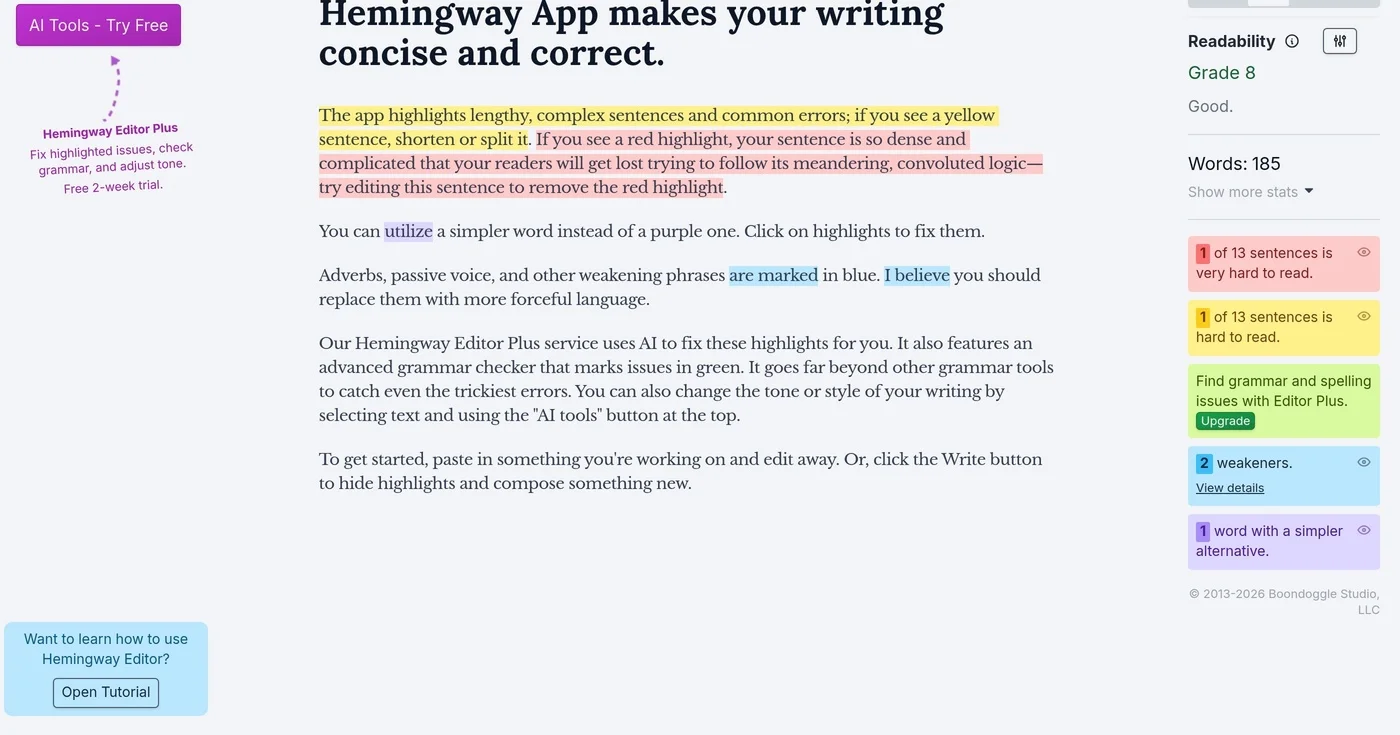
Hemingway Editor: Flags hard-to-read sentences and makes density visible at a glance. It pushes toward shorter prose without teaching the full rhythm spectrum, so a passage of nothing but "Grade 3" sentences may still be monotonous. Free tier is available online; Hemingway Plus is AI-powered.
ProWritingAid: Its Style Report explicitly flags repeated sentence starts, and its Sentence Length Report visualizes length distribution across your document, making monotony patterns visible in a bar chart. ProWritingAid serves 4+ million writers. Free tier covers 500 words and 2 reports per day; Premium runs approximately $30/month.
Both tools are useful for pattern detection and are faster than manual length-mapping on long documents. Neither replaces the read-aloud diagnostic or the judgment calls required for pacing by emotional register. They tell you where the monotony is; you still decide what the rhythm should be.

Spot passive voice with the be-plus-participle test. Keep it for unknown actors, then rewrite only when the missing agent is the point of the sentence.
Epistolary fiction is told through letters, diaries, and found documents. Nested origins, seven examples, and where the form breaks.
Free verse is open-form poetry with no prescribed meter or rhyme scheme. The line, cadence, and sound do the work meter used to do.
Professional publishing supported by generous companies you should check out.


