


Sentence Structure: The Invisible Architecture of Prose That Lands
Sentence structure controls what readers emphasize, how fast they read, and what they carry into the next paragraph. This guide covers the four canonical types,
Updated 16 min read

Sentence structure controls what readers emphasize, how fast they read, and what they carry into the next paragraph. This guide covers the four canonical types,
Sentence structure (the arrangement of subject, predicate, objects, phrases, and clauses) is the underlying architecture of every sentence you write. It controls what readers emphasize, how fast they move through your prose, and whether your writing feels purposeful or mechanical. Every writing guide covers the four sentence types, but none cover the stress position, given-new information packaging, or the five rhetorical patterns that separate competent grammar from actual craft.
This guide treats sentence structure as a writing tool, not a grammar exercise. You'll find the foundational four types, the five craft patterns your sentence-structure textbook skipped, and the cognitive science behind sentences readers can't put down.
Sentence structure (also called syntax) is the arrangement of all parts of a sentence: subject, predicate, objects, phrases, clauses, and punctuation. Every sentence requires at minimum a subject and a verb, though imperative sentences are the exception: they use only the verb, making "Run." grammatically complete. The single-word command is a full sentence.
A clause is a group of words with a subject and a verb. Two types exist: independent clauses (complete thoughts that can stand alone) and dependent clauses (incomplete thoughts that must attach to an independent clause). Every structural decision in this guide builds on that distinction.
Structure controls three things readers care about: clarity (can they follow the logic?), pacing (how fast does the text move?), and emphasis (what do they carry into the next paragraph?). A grammatically correct sentence can still be structurally inert. Structure is how you move information into the most powerful position, and how you control the reading experience at the most granular level available to a writer.
The 2026 dimension adds a practical concern. AI detection tools flag uniform sentence structure as a machine-generated writing signal: every sentence following the same structural template makes prose statistically predictable. For writers submitting to publications, academic programs, or AI-assisted review workflows, sentence variety is no longer only a style choice.
Active voice affects comprehension directly. Psychology Today cites cognitive research confirming active sentences are processed faster and remembered better than passive ones. "The dog bit the man" outperforms "The man was bitten by the dog" on comprehension speed, consistently across the studies it reviews.
Grammarly, Purdue OWL, and every major style guide agree on four canonical types. Here is what each one is, when to use it, and what it signals structurally.
One independent clause. You can have multiple subjects or multiple verbs: it's still simple.
Use simple sentences for emphasis, urgency, and facts that need to land without interference. A short, declarative sentence after three complex ones creates impact. That's structural rhythm, not accident.
Two or more independent clauses joined by a coordinating conjunction (FANBOYS: for, and, nor, but, or, yet, so) with a comma, a semicolon alone, or a conjunctive adverb (however, therefore, moreover) with a semicolon.
Use compound sentences for equal, related ideas and balanced contrast. Both clauses carry equivalent weight. The structure signals it.
One independent clause plus one or more dependent clauses, introduced by a subordinating conjunction: if, when, because, although, while, since, unless, before, after.
Punctuation rule: when the dependent clause leads, add a comma before the independent clause. When the independent clause comes first, no comma needed.
Use complex sentences for cause-effect relationships, conditions, contrast, and qualification. The subordinate structure signals that one idea depends on another.
Two or more independent clauses AND one or more dependent clauses. The most information-dense type.
Use compound-complex sentences when you need to handle multiple connected ideas, each with nuance or condition. Academic and formal writing leans heavily on this type. Fiction writers use it sparingly: it slows pace, which is sometimes exactly what a reflective scene needs.
The four types classify sentences by how clauses combine. These five patterns classify them by where emphasis falls and how information unfolds: a separate axis entirely. Craft writing guides and fiction curricula cover these patterns; no top-10 search result for "sentence structure" does.
The main clause is withheld until the end. Modifiers, subordinate clauses, and qualifications build suspense before the resolution arrives.
Use for tension, delayed revelation, and argument rhythm where the conclusion carries extra weight because the reader had to wait for it.
The main clause comes first. Details layer on afterward through subordinate phrases, absolutes, and modifiers.
The most common pattern in literary prose. You give the action immediately, then accumulate texture. Use for description, scene-setting, and flowing narrative where the mood matters as much as the event.
Two parallel parts of equal grammatical weight, separated by a colon, semicolon, or coordinating conjunction. Creates rhetorical punch, antithesis, and memorability.
Parallel structure is the grammatical mechanism inside balanced sentences; it draws 22,200 monthly searches, nearly double the head keyword. Every element in the series mirrors the form of the others. When the form breaks, readers feel it as a stumble even when they can't name why.
A modifier, prepositional phrase, or object is front-loaded before the subject-verb core. The effect: shifted emphasis, surprise, and a formal or poetic register.
Use sparingly. One inverted sentence in a paragraph creates emphasis; three in a row creates exhaustion.
Grammatically incomplete by design. Not an error. A structural tool for pace, intimacy, and emphasis.
On r/writing, u/d_m_f_n names it directly: "Use fragments occasionally." For high-tension scenes, short and choppy; for description and exposition, longer. The classroom rule against fragments is a pedagogical shortcut; modern style guides endorse intentional fragments in creative prose.
Readers naturally emphasize whatever arrives at the end of a sentence. Linguists and writing teachers call this the stress position: not a technique you impose, but how English-speaking readers process language by default.
Your most important word, phrase, or clause belongs there.
Weak: "The reason the company failed, despite all their efforts, was poor cash management."
Strong: "Despite all their efforts, the company failed for one reason: poor cash management."
Same facts. Same sentence-structure type. Different emphasis, because the key information now arrives at the end instead of being buried mid-sentence.
Bryan Garner puts it plainly: "See every sentence as a crescendo." Writing scholar George Gopen observes: "It is a linguistic commonplace that readers naturally emphasize the material that arrives at the end of a sentence."
The principle cascades upward: the clincher sentence of a paragraph earns its place at the end, and the most powerful claim in an argument goes last. That's why experienced writers often move their best insight to the final line of a section. Not because the insight changed, but because position determines what readers carry forward.
Never open a sentence with "This" alone: "This reduces complexity" forces readers to hold a mental placeholder while searching the previous sentence for the referent, cognitively taxing and easily avoided. Follow "this" with a noun phrase ("This reduction in complexity allows...") or restructure so the subject is explicit from the first word. OpenStax flags the naked "this" as one of the most consistent clarity failures at every writing level.
In 1977, psychologists Clark and Haviland identified a principle that applies to every sentence you write: readers process sentences fastest when familiar information opens and unfamiliar information closes. Subsequent cognitive science research confirmed the pattern holds reliably across registers and genres.
Violating the principle:
"Sentence combining is covered in Chapter 3. It is an editing strategy. Early drafts use it to improve choppiness."
Each sentence front-loads something new before the reader has any anchor. Taxing to read, even though no individual sentence is incorrect.
Following the principle:
"Early drafts are often choppy. Choppy writing can be improved with sentence combining, an editing strategy covered in Chapter 3."
Each sentence picks up a word from the previous one ("choppy" to "choppy writing") and advances it with new information. The thread stays continuous without repetition.
At the paragraph level, this creates what writing instructors call the old-to-new chain: each sentence opens by touching the territory of the previous one, keeping readers from having to look backward. Some paragraphs with no grammatical errors still feel hard to follow because the information order is inverted throughout. Given-New packaging explains why: fixing the order repairs the paragraph faster than fixing any individual sentence.
Prose has rhythm even without meter. Three levers control it, and you can learn to use all three deliberately.
Alternate short (3-7 words), medium (10-20 words), and long (20-plus words). The effect is physical: a 5-word sentence after three 30-word sentences hits like a brake pedal. A long sentence before the revelation slows readers into attention; the revelation itself lands shorter.
John Fox describes it in his sentence revision video: "Sentences are really like music, and you have to know what the note before was so you can figure out what the next note should be."
Ellen Brock addresses the same trade-off in her sentences video. She notes: "In most cases if the character is being thoughtful or maybe they're distant from something that occurred, longer sentences tend to work better; they give a more introspective, thoughtful mood. Whereas if the character is involved in an intense or immediate emotional situation, action and urgency are better conveyed by shorter, choppier sentences."
Length variation also connects directly to sentence variety: it's the simplest axis to start with before layering in opener type and sentence pattern.
Iambic rhythm (da-DUM) is natural to English readers, and clustering stressed syllables creates choppiness even when the sentence isn't long. Soft consonant endings ("silence," "flowing," "memory") create linger; hard stops ("struck," "hit," "cut") create finality. Cormac McCarthy's "the fog slithered in from the sea" vs. "the fog drifted in from the sea": one verb converts a neutral description into something textured and alive.
John Fox again: "Verbs are the little despots of the sentence. These little authoritarian rulers control everything going on around them. If you spend a little bit more time picking your verbs deliberately, it's going to pay outsized dividends in improving your sentences."
Writer's Digest (May 2026) offers a diagnostic: strip every adjective and adverb from your sentence. If the skeleton holds, the sentence is structurally sound. If it collapses without the modifiers, the verbs aren't doing their job.
Write With Seth (March 2026) names the hierarchy: verbs are load-bearing walls, nouns are the floor, adjectives are furniture, adverbs are decoration. Decoration doesn't hold the house up.
The right structure depends on where your writing lives. These defaults reflect structural conventions across genres and formats.
Context | Preferred Structure | Why |
|---|---|---|
Literary fiction | All four types, deliberately varied | Pacing, voice, emotional rhythm |
Academic writing | Complex and compound-complex | Nuance, qualification, subordination of ideas |
Business and professional | Simple and compound | Clarity, scannability, directness |
Technical writing | Simple and complex | Precision, step-by-step logic |
Journalism | Short simple sentences, some complex | Inverted pyramid, broad readability |
Fiction privileges verbs over modifiers. Write With Seth (March 2026): "The mistake isn't using words from the lower levels. The mistake is letting them run the show." Strong verbs should occupy main clauses; burying them in dependent clauses gives them real estate without authority.
Academic writing moves in the opposite direction: complex sentences subordinate one idea to another and make hierarchical relationships between claims explicit. Business writing prioritizes brevity because readers scan rather than read. Compound-complex sentences slow scannability without adding clarity that justifies the cost.
Seven errors account for most structural problems in prose. Learning to spot them in your own drafts is faster than learning every grammar rule.
Error | What It Looks Like | Fix |
|---|---|---|
Run-on sentence | Two independent clauses with no proper punctuation | Add comma + coordinating conjunction, semicolon, or period |
Dependent clause alone: "Because she was tired." | Attach to an independent clause (or use intentionally) | |
Comma splice | Two independent clauses with only a comma: "She was tired, she went to bed." | Add coordinating conjunction (", so") or semicolon |
Dangling modifier | "While eating breakfast, the phone rang." (Who was eating?) | Restructure so the modified noun is the subject |
Faulty parallelism | "She likes hiking, swimming, and to run." | Match grammatical form: "hiking, swimming, and running" |
Squinting modifier | "Students who practice writing often improve." (Often practice, or often improve?) | Reposition: "Students who often practice writing improve." |
Garden-path sentence | "The horse raced past the barn fell." (Grammatically correct; misleading on first parse) | Restructure so the main clause is unambiguous from the first word |
The most misunderstood item: starting a sentence with "But" or "And." On r/grammar, u/cickist captures the consensus: "Starting a sentence with and or but is completely acceptable when it creates clarity or emphasis. The only actual rule: the resulting sentence must still be complete." Chicago, Merriam-Webster, and AP all explicitly permit it; the classroom prohibition was a shortcut to prevent student fragments, not a grammar law.
These five tools address different structural problems, making them most useful as a suite rather than interchangeable alternatives.
Tool | Best For | Pricing |
|---|---|---|
Real-time checking across all writing contexts; catches run-ons, fragments, comma splices; 40M+ daily active users | Free / Premium ~$12/mo | |
Deep structural analysis: sentence length variation, pacing reports, readability stats; best for fiction and long-form | Free / Premium $30/mo | |
Multilingual structural checking across 30+ languages; open-source core | Free / Premium ~€20/mo | |
Rewriting specific problematic sentences quickly; paraphrase-first approach for sentence-level fixes | Free / Premium $19.95/mo | |
Best free option; found 19/20 errors in independent accuracy testing; no signup required | Free |
ProWritingAid's sentence-length variation report is the standout tool for writers who want to diagnose structural monotony.
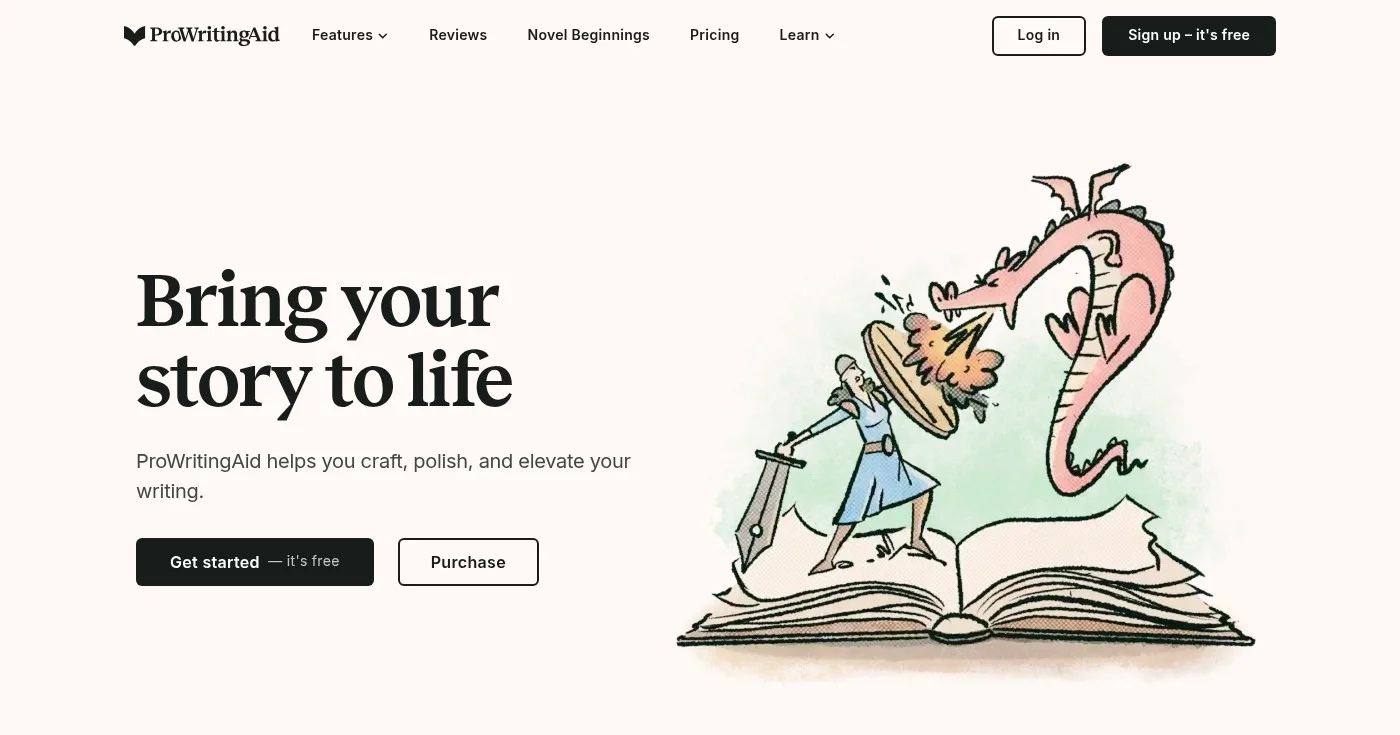
It charts your sentence lengths across an entire document and flags stretches where you've been writing the same grammatical type for too long. No other tool at this price point does this as systematically.
Uniform grammatical framing is the most pervasive structural problem in prose: writing every sentence as Subject plus Verb plus Object, repeated through twelve lines. The paragraph delivers information and nothing more.
u/Rourensu in r/writing names the failure: "X [to be] Y... just imparts information and nothing else. If I want information I'll read non-fiction." The contrast: Brienne was tall vs. Brienne lowered her head to pass through the tavern door. The second sentence implies height through structure rather than stating it: one revision, one character.
Longer sentences signal effort, not skill. Content Marketing Institute's "Clarity beats volume" (May 2026) addresses a persistent professional-writing belief: that more complex sentences demonstrate more capable thinking. Ellen Brock pushes back on YouTube.
Complex sentences are pacing tools, not intelligence proxies. Use them to slow readers into reflection; cut them when readers need momentum.
A structural trap common in fiction: every sentence routes through a point-of-view character's senses ("John saw...", "Sally heard...", "Joe noticed..."). The consequence is structural uniformity: the subject slot never changes, clause length stays constant, sentence variety becomes impossible.
u/SquanderedOpportunit in r/writing identifies four benefits from removing POV filters: structural variety, deeper characterization, reader intimacy, and tighter pacing. As they put it: "Eliminating the filtering opens up your ability to add significant variety to the structure and rhythm of your prose... and tighten your pacing by making everything feel more immediate and pressing."
Most writers draft sentences in the order they think, not the order that creates emphasis. Key information lands mid-sentence by default, buried between the subject and a trailing clause. The fix is light revision: move the most important element to the final position, read it aloud, and the shift in weight becomes audible.
Writers who notice monotony often reach for synonyms. The actual problem is uniform grammatical frame. Substituting "strolled" for "walked" does not change sentence structure.
Switching from "He strolled into the room" to "Into the room he strolled" (inverted) or "Strolling in, he noticed the room had emptied" (participial opener) changes rhythm without altering a single content word. Vocabulary and structure are different levers; pull the right one.

Spot passive voice with the be-plus-participle test. Keep it for unknown actors, then rewrite only when the missing agent is the point of the sentence.
Epistolary fiction is told through letters, diaries, and found documents. Nested origins, seven examples, and where the form breaks.

Free verse is open-form poetry with no prescribed meter or rhyme scheme. The line, cadence, and sound do the work meter used to do.
Professional publishing supported by generous companies you should check out.


