


Epistolary: Letters, Diaries, and Found Documents
Epistolary fiction is told through letters, diaries, and found documents. Nested origins, seven examples, and where the form breaks.
Updated 10 min read
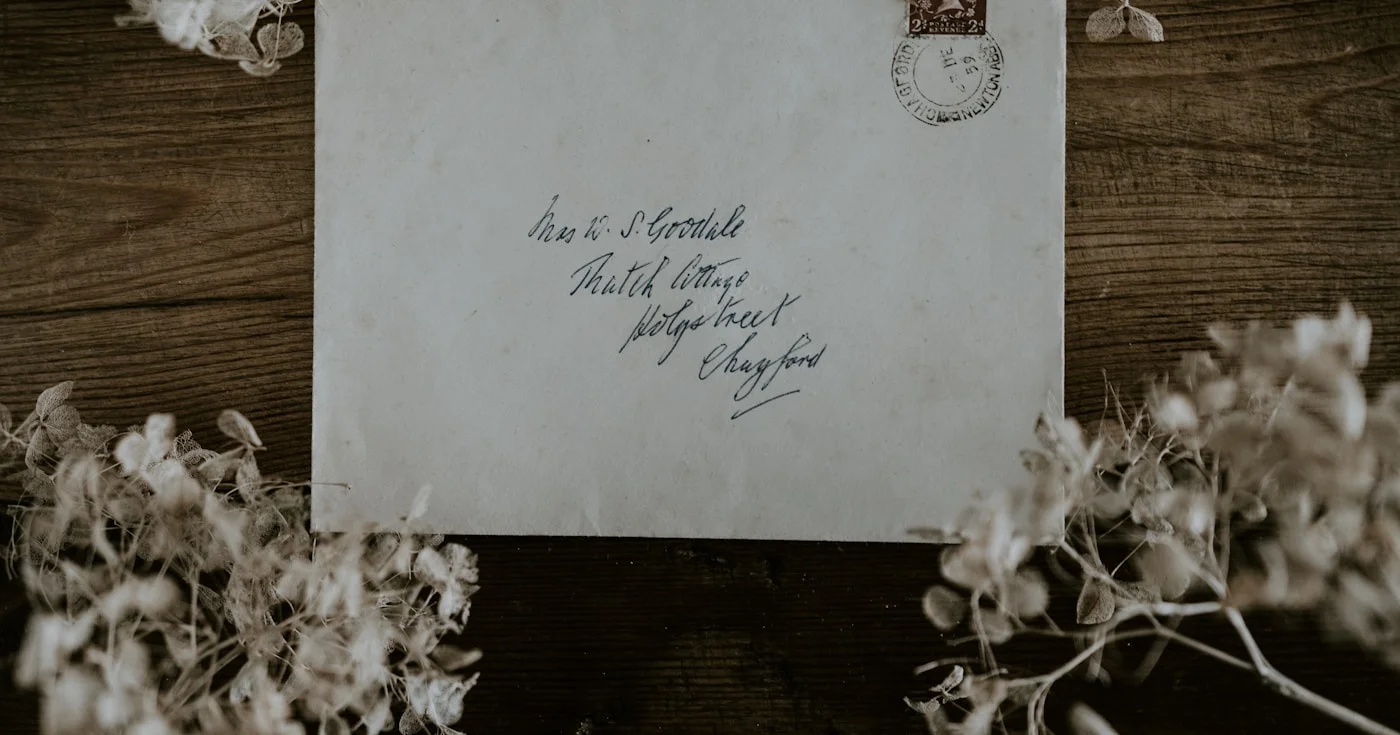

Epistolary fiction is told through letters, diaries, and found documents. Nested origins, seven examples, and where the form breaks.
Epistolary fiction tells a story through documents characters produce: letters, diaries, clippings, and emails. Britannica defines the novel form as fiction told through letters by one or more characters. Samuel Richardson's Pamela (1740) popularized the English version; Dracula (1897) mixed letters with diaries and telegrams.
The adjective's first known English use is circa 1656.
You reach for the form when you want intimacy without an omniscient tour guide. The reader does not get a continuous narrator. They read the file.
The word describes writing that takes the shape of a letter, and fiction whose plot arrives as documents written inside the story. Merriam-Webster traces the adjective to Greek epistolē ("letter" or "message") via Latin epistola. Pronounce it eh-PI-stuh-lair-ee.
Britannica adds that the mode gives "an intimate view of the character's thoughts and feelings without interference from the author."
The reader overhears private writing.
Literary usage then widens the file. If you are supposed to imagine that a character produced the text, the form still holds. The object can be a letter, a diary, a telegram, a ship's log, a doctor's note, an email, or a chat transcript.
Lily Davenport's Cincinnati Review essay (22 September 2023) walks the same range: novel-in-letters, diaries, found text, and other faux-documentary approaches.
The Smithsonian Postal Museum fences the term at mailed correspondence. Literary usage does not. Diaries and found files belong with letters.
History does not flatten to "Richardson invented it." Three claims sit inside each other, and each does different work.
Diego de San Pedro's Cárcel de amor (Prison of Love) is often named the first truly letter-built novel. The Postal Museum lists 1485; the first known printed edition is Seville, 1492.
The first English novel composed entirely of letters is Love-Letters Between a Nobleman and His Sister (volume 1 in 1684; later volumes 1685 and 1687), attributed to Aphra Behn. Authorship is still disputed.
Samuel Richardson's Pamela; or, Virtue Rewarded (1740) is Britannica's origin point for the English vogue. It is the book that made the mode popular, not the book that invented letters. Clarissa followed, serialized 1747-48 and commonly dated 1748.
Antecedents sit behind all three: Ovid's Heroides, Roman letter collections, New Testament epistles, Heloise and Abelard. Janet Gurkin Altman's Epistolarity (Ohio State UP, 1982) later treated the letter as a form problem (bridge or barrier, who is allowed to read it, how a correspondence closes), not as an 18th-century costume.
Search ads will bucket "epistolary genre" with the same head term. That label is slightly wrong. This is a way of delivering plot, closer to a literary device than to a writing genre such as romance or horror.
You can write a Gothic, a campus novel, or a spy file in documents. The objects change. The job does not: the character writes, and you read what they were willing to put on paper.
Someone in the story produces a document. You read that document instead of continuous narrative writing from outside the file. Intimacy, irony, and the feeling that the papers were found are side effects of that choice.
Richardson's signature move, which Evan Gottlieb calls "writing to the moment," is characters recording thoughts and actions as if in real time.
"Richardson perfected a style he called 'writing to the moment,' in which his characters record their thoughts and actions in what seems to be real time, thus adding further realism, immediacy and even suspense to the genre." Evan Gottlieb in "What is an Epistolary Novel?: A Literary Guide for English Students and Teachers" (OSU School of Writing, Literature and Film, 2:18)
The modern cousin is the on-screen text thread that arrives while the scene is still happening.
Private writing feels like eavesdropping. That is the pleasure. It is also a performance: a letter is written toward one person with known biases, not toward a neutral public.
"When we write letters we are in some ways creating a performance of self. We are writing toward an audience of one very particular person with exquisitely specific biases and preferences and knowledge of the world." Lauren Groff in "Lauren Groff: The Epistolary Novel and the Creation of Selfhood" (Writers & Books, 2:51)
Laclos uses the same mechanism as a weapon. The Marquise writes the self her correspondent needs to see.
Several first-person files can sit in one book without an omniscient referee. In Smollett's The Expedition of Humphry Clinker (1771), Matthew Bramble finds Bath disgusting and his niece Lydia finds it charming. You adjudicate.
Polyvocal files also create dramatic irony. Gottlieb's point on Dracula is that you, holding the whole packet, often know more than any single character. The suspense lives in that gap.
That is harder to do in single-voice first person, where the narrator and the reader share a blind spot.
Crime and document-mystery cousins (The Moonstone's affidavits) use the same trick for a procedural reason. Someone in the story asked for a written version.
Some letters narrate. Some letters are the plot turn: intercepted mail, a forged note, a telegram that sends the wrong person to the wrong house. The Postal Museum, drawing on Patricia Rosenmeyer, splits communicative letters (they report present action) from kinetic letters (the sending is the event).
Digital descendants (the email sent to the wrong thread, the text left on read) are the same device with a different timestamp.
Found-file novels add a second excuse: a fictional editor, a discovered trunk, a compiled case. The papers have to exist in the world of the story. If you cannot answer who kept them and why they survived, the reader starts picking at the binding.
Two taxonomies are useful, and they stack. Count the writers first, then name the object in the reader's hand.
Type | Voices | Teaching example |
|---|---|---|
Monologic | One writer | Pamela; Bridget Jones's Diary |
Dialogic | Two correspondents | Dostoevsky's Poor Folk |
Polylogic | Three or more | Clarissa; Les Liaisons dangereuses; Dracula |
Document | What you hold | Teaching example |
|---|---|---|
Letters | Addressed writing; audience shapes withholding | Pamela; The Color Purple |
Diary | Addressed to the self, or to no one | Bridget Jones's Diary |
Mixed found-file | Letters plus diaries, clippings, logs, then-new tech | Dracula |
Digital | Email, SMS, chat, transcripts | The Correspondent (letters + email) |
Novels can be fully letter-built or hybrid. Watney's logs in The Martian sit beside third-person chapters; a contemporary book may drop in a text thread for one movement and return to narration.
Relatively few novels today are written entirely as letters. The form survived by widening the file.
These seven earn a place because each shows a different job the documents can do. This is not a ranked "best of" list.
Pamela is the monologic servant-girl novel of "familiar letters." Then Clarissa scales that method into a polylogic machine: Clarissa and Lovelace as rival cameras, with their confidants in the same packet.
Pamela shows writing to the moment. Clarissa shows what happens when nobody in the packet is a safe narrator.
The letters here are weapons. Seduction, blackmail, and reputation travel through the post. Groff's "performance of self" is the whole engine: every correspondent is curating a face.
Read it for kinetic mail.
Britannica's Dracula page (updated 23 July 2026) calls it fundamentally an epistolary novel. The story runs through journal entries, diaries, letters, and telegrams. The phonograph diary is then-current tech, not a violation of the form.
Frankenstein (1818) is the book people file next to it, and the filing is sloppy. Walton's letters to his sister enclose Victor's narrative and the Creature's. Those letters are a framing device: a frame story with a letter wrapper, not a mixed-document novel in Stoker's sense.
The Handmaid's Tale is the other common trap. It is not a novel-in-letters. The Historical Notes are a found-manuscript / academic-frame twist at the end, which is a different trick.
Celie writes to God, then to Nettie. The addressee change is the character change. Walker won the Pulitzer Prize for Fiction in 1983.
The letters carry vernacular without a narrator stepping in to translate. Intimacy here is linguistic, not just structural.
A monologic diary most living readers have already met. It borrows dated entries, a voice talking to itself, and comic self-performance rather than building a novel composed of posted letters.
Chbosky's The Perks of Being a Wallflower (1999) does the cousin move. The narrator writes letters to an unnamed friend. Both books are why the form still sounds like a format you have held, not only an 18th-century exam term.
Virginia Evans's The Correspondent (Crown, 29 April 2025) is recency proof, not the definition. Letters plus email still sell: 24 weeks on the New York Times hardcover list, 8 at #1 as of 13 April 2026, and the Women's Prize for Fiction on 11 June 2026.
Readers bounce when the mechanism shows. People do not write this way.
"I find the “seams” on these novels, where things happen that would never be written down as they are, extremely distracting. Things like “as you know” in letters describing concepts the reader and recipient clearly already understand… Even Bram Stoker’s Dracula has characters writing as they are actively avoiding peril." u/Oduind in r/suggestmeabook (Feb 2026)
On r/suggestmeabook, that bounce is the recurring pattern: exposition dumped into a letter the addressee should not need, plus the vampire-attack diary problem. Period-letter readers will tell you 18th-century women of a certain class really did go on at that length. That defense does not help a contemporary email novel.
If every correspondent sounds like the author, the packet collapses into a gimmick. Distinct diction is not decoration here. It is how the reader knows who is lying.
Letters summarize. They are weak at blocking a fight in real time and strong at aftermath, motive, and what someone is willing to admit.
Hybrid books dodge this by leaving the file for a chapter. Fully document-built books have to earn every scene through a person who would actually sit down and write it.
The form gets accused of unseriousness (women's interiority as a trick) and of hermetic cleverness (a closed circuit of letters no outsider could enter). Britannica already flags the old suspicion around Pamela's "remarkable literary powers": why does this servant write like a novelist? If you cannot answer that inside the fiction, the reader will answer it for you.
Spot passive voice with the be-plus-participle test. Keep it for unknown actors, then rewrite only when the missing agent is the point of the sentence.
Free verse is open-form poetry with no prescribed meter or rhyme scheme. The line, cadence, and sound do the work meter used to do.
A theme in literature is the claim a story makes about human life, usually implied, that would still hold if the plot used different names.
Professional publishing supported by generous companies you should check out.


