
10 Ways to Write Faster Without Losing Quality
Writing sprints, outlines, dictation and a daily habit: 10 techniques that help you write faster and draft more without losing quality.
Updated 10 min read


Writing sprints, outlines, dictation and a daily habit: 10 techniques that help you write faster and draft more without losing quality.
To write faster, start by completely separating the drafting and editing phases. Most writers stall because they're doing both at once.
Anne Lamott calls the solution "shitty first drafts": give yourself permission to write badly and clean it up later. Stephen King aims for 2,000 words a day.
Most writers don't have a typing speed problem. The average typist in a study of 168,000 volunteers typed 52 words per minute, according to the University of Cambridge. The bottleneck is mental, not mechanical.
The 10 steps below cover the habits, environments, and tools that get you into flow faster, whether you're a blogger chasing weekly deadlines or a novelist working through a first draft.
Before you start, make sure you have:
Never edit while you draft. Of all the habits in this guide, this one changes your speed the most.
When you stop to fix a sentence mid-draft, you force your brain to switch from generative (creative) to evaluative (critical) mode. That switch costs you momentum each time. Do it often enough and an hour of work produces a single paragraph.
The fix is strict phase separation. Set a timer, declare the session a "draft only" zone, and write without stopping. Polish it afterward.
Tip: If you catch yourself deleting or rewriting mid-draft, type "XXX" and keep going. The placeholder is easy to search for in the edit pass.
A rough outline turns a blank page into a roadmap.
You don't need a formal outline: three to five bullet points covering what you want to say, in what order, is enough for a blog post or essay. For longer pieces, aim for one bullet per major section.
Two to five minutes of planning before you write consistently shortens the draft session.
Tip: If you get stuck mid-draft, check your outline. Getting lost is almost always a sign that your outline has a gap, not that you've run out of ideas.
A 2023 brain-imaging study of calligraphers found that higher flow comes with "an efficiently working brain" that shows less activation in attention regions. Flow is easier to reach when your mind is fresh, so give your best hours to drafting.
Identify your best cognitive hours (often morning for early risers, late morning or evening for night owls) and protect them for writing. Schedule editing, email, and meetings during lower-energy windows.
Tip: Don't start writing right after a meeting or a heavy research session. Those tasks drain the same mental resources your drafting requires.
A writing sprint is a timed block of focused writing followed by a brief rest. The Pomodoro Technique is built around 25-minute focus blocks separated by short breaks; adjust the length to whatever creates the right pressure for you.
Sprints work because they make the cost of stopping visible. When you have 8 minutes left on a timer, deleting a paragraph feels costly in a way it doesn't on an open-ended session.
Set a word-count goal for each sprint (300 words in 25 minutes is a reasonable starting target for most writers) and track your results.
Tip: If 25 minutes feels too long, start with 10-minute sprints. Even a short timed window creates useful pressure.
Interruptions don't just cost the time you spend on them. In UC Irvine researcher Gloria Mark's workplace studies, interrupted work was resumed after an average of 23 minutes and 15 seconds, usually with about two other tasks in between. A single notification can cost far more than the seconds you spend reading it.
Before your writing session:
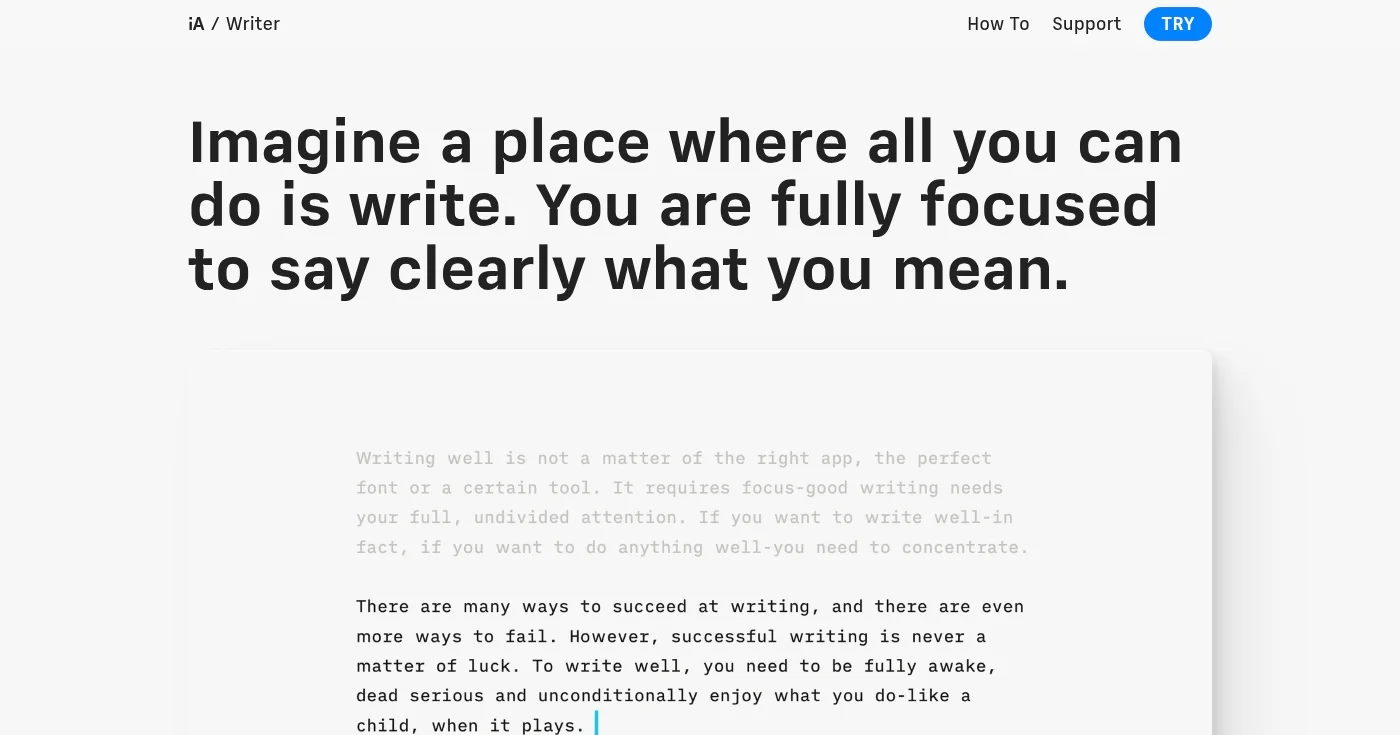
Tip: Use a distraction-free writing app like iA Writer or FocusWriter to make it harder to drift to other windows. More options are in our roundup of distraction-free writing apps.
Research rabbit holes kill writing sessions. You need a statistic, stop to look it up, open three tabs, read for 20 minutes, and emerge with nothing drafted.
The solution: use placeholder text. When you need a fact, write "TK [statistic about X]" or "TK [exact quote from King]" and keep moving. "TK" is a traditional copy-editing mark meaning "to come": scannable and unlikely to appear in finished prose.
Gather all your facts in a research session before you draft. What you couldn't find in research goes in as TK; fill it in during the edit pass.
Speaking is naturally faster than typing. In a Stanford study, speech recognition entered English text 3.0 times faster than a smartphone keyboard, with a 20.4% lower error rate.
Dictation isn't for polished prose; it's for rough first drafts. Record yourself talking through your outline, then edit the transcript into a clean article.
Tools to start with:
For a full comparison, see the best dictation software.
Tip: When dictating, say the punctuation out loud ("comma", "period", "new paragraph"). It sounds strange, but it saves cleanup time.
Unlimited research time before writing is procrastination with better optics. Finish your research before you draft, cap it at a fixed time, and commit to writing with what you have.
Before any writing session, limit research to 15–30 minutes maximum. Collect the quotes, statistics, and links you need into a separate document. Then close the research document, open a blank page, and draft.
If you realize mid-draft that you need a fact you don't have, write TK and move on (see Step 6). Revisiting research mid-session breaks your flow and rarely produces what you actually needed.
Freewriting means writing continuously without editing, evaluating, or stopping for five to ten minutes before starting your actual piece. It warms up the "writing brain" the way stretching warms up a runner.
To freewrite: set a five-minute timer and write anything (observations about your morning, a description of the room, a rant about something irrelevant). The topic doesn't matter. The goal is to make starting the actual piece easier.
A warm-up is especially useful when you're transitioning directly from email, meetings, or reading. Those activities use different cognitive modes, and five minutes of freewriting bridges the gap.
Writing speed improves the same way any skill improves: through practice. The more consistently you write, the faster your brain can generate, organize, and produce language.
Stephen King aims for 2,000 words a day and writes in On Writing that only dire circumstances make him stop short. You don't need that scale to see results. Even 100 to 300 words a day, practiced consistently, builds the habit that makes drafting faster over time.
Set a sustainable daily minimum. The goal isn't volume; it's the habit of showing up and writing without resistance. Our guide to a daily writing practice covers how to make it stick.
Tip: Track your daily word counts for 30 days. Seeing the numbers improves motivation and reveals your real patterns: when you're fastest, what conditions help, and what consistently gets in the way.
Tool | Best For | Pricing | Free Option |
|---|---|---|---|
Distraction-free drafting | $49.99 one-time (Mac) | Free trial | |
Long-form writing and organization | $59.99 one-time | 30-day trial | |
Minimal distraction-free editor | Free | Yes | |
Website and app blocking | $3.33/mo (billed yearly) | Free plan, 7-day Premium trial | |
Aggressive website blocking | Free / $45 one-time (Pro) | Yes | |
Free speech-to-text dictation | Free | Yes |

Cause: Habitual self-monitoring, usually driven by perfectionism.
Fix: Turn off autocorrect and grammar checkers during the draft phase. Some writers cover their screen while typing to make reviewing impossible. Use a strict timer and treat the session as a commitment: no reading back allowed.
Cause: Starting without an outline or starting from the introduction when you don't know the content yet.
Fix: Never start at the beginning. Start with the section you know best, even if it's the middle of the piece. Then write your way forward and backward from there.
The introduction is often the last thing written well. If the block lasts beyond one session, work through these writer's block fixes.
Cause: The draft has gaps you haven't filled before starting.
Fix: Complete your research session before opening the draft file. Use TK placeholders for anything you can't immediately answer. Treat the research phase and the drafting phase as completely separate work sessions, ideally on different days.
Cause: Drafting too loosely without enough structure.
Fix: Invest more time in the outline phase (Step 2). A slightly more detailed outline produces a rough draft that needs less reconstruction in editing. Aim for an outline where every section has at least two or three bullet points before you draft.
Cause: Current focus capacity is shorter, or the session is being disrupted by notifications or transitions.
Fix: Start with 10-minute sprints and extend gradually. Audit your setup: are notifications off, tabs closed, phone out of reach? Focus capacity improves with practice the same way physical endurance does.
Writing faster comes down to separating the phases of your work and protecting your most productive mental state. Outlining, sprints, distraction blocking, placeholders and daily practice all point at one principle: give your drafting brain the conditions it needs, and get everything else out of the way.
Start with Step 1. Commit to one full session of no-editing drafting, timed for 25 minutes.
Track how many words you produce. Then add one more technique from this list each week until the habits are automatic.
A complete guide to copywriting: what it is, the 8 main types, core frameworks like AIDA and PAS, psychological triggers, and the 7 most common mistakes to avoi
8 essay hook types with examples from Didion, Orwell, and Zauner. Includes before/after revisions, hook-by-essay-type matching, and how to write your own.

Spot passive voice with the be-plus-participle test. Keep it for unknown actors, then rewrite only when the missing agent is the point of the sentence.
Professional publishing supported by generous companies you should check out.


