


Writing Anxiety: Causes, Symptoms, and How to Write Through It
Writing anxiety is more common than most writers admit. This guide covers what causes it, how to recognize the symptoms, and the science-backed strategies that
Updated 15 min read


Writing anxiety is more common than most writers admit. This guide covers what causes it, how to recognize the symptoms, and the science-backed strategies that
Writing anxiety is a set of negative feelings (tension, worry, self-doubt) that arise before or during a writing task and interrupt your ability to produce words. Unlike writer's block, writing anxiety is the emotional state that often causes the block, not the block itself. The UNC Writing Center describes both as informal terms for "a wide variety of apprehensive and pessimistic feelings about writing."
Writing anxiety is also situational. You might write fiction with ease but freeze on a personal essay, or draft emails confidently but dread academic papers. The anxiety attaches to a specific writing type, audience, or set of stakes.
That specificity matters: writing anxiety is not a fixed character flaw. It's a response you learned, which means it can be unlearned.
UC Berkeley's Writing Programs defines writing anxiety as negative, anxious feelings about a writer's situation or task that disrupt some part of the writing process. The word "disrupt" is key: writing anxiety doesn't always mean paralysis. It can look like avoidance, compulsive revising, or writing at a fraction of your normal pace.
It's not a medically recognized disorder, but it's real and widespread enough that university writing centers treat it as a primary concern. It's also worth separating from general anxiety: writing anxiety refers specifically to distress tied to writing tasks. Someone who manages anxiety well in other areas can still experience it intensely at the page.
Dimension | Writing Anxiety | Writer's Block |
|---|---|---|
Nature | Emotional and psychological state | Behavioral outcome (inability to produce words) |
Cause | Fear, perfectionism, self-doubt, past experiences | Can stem from anxiety, but also from lack of direction or burnout |
When it appears | Before or during a writing task | During the writing task |
Treatment | Addresses the emotional root | Addresses productivity and process |
Writing anxiety often causes writer's block. But writer's block can also result from non-anxiety causes: unclear direction, lack of research, or simple exhaustion. If you treat the block without treating the anxiety underneath it, you're likely to hit the same wall again.
As J.D. Edwin wrote for The Write Practice, writer's block "disguises itself as something we think is out of our control" but is often anxiety in disguise. Identifying the real cause is the first step to fixing it.
Writing anxiety is most studied in academic settings. University writing centers at UNC, Vanderbilt, and Texas A&M acknowledge it as a common concern, but it affects professional writers, journalists, and novelists too. Approximately 30% of anxiety disorder sufferers experience difficulty writing due to anxiety's effects on cognitive function.
Writing anxiety is also not confined to beginners. Published authors, academics, and experienced journalists describe the same freeze response. The triggers shift over time (a debut novelist fears exposure; a published author fears the sophomore slump), but the underlying mechanism stays the same.
Understanding why writing anxiety happens helps you address it at the source rather than pushing through blindly. Most cases trace back to one or more of four root causes.
The most immediate trigger is fear: fear of judgment from readers or editors, fear of failure, or fear that criticism of your writing amounts to criticism of your worth as a person. A first draft feels permanent before it's written, which is enough to stop writers before they begin.
Academic contexts add a specific flavor: grades, publication outcomes, or committee approval attach concrete consequences to writing quality. The Oregon Pressbooks writing guide notes that writers sometimes fear being judged "arbitrarily," particularly when the evaluator's standards feel unclear or shifting. Uncertainty about the standard compounds the anxiety.
Perfectionism is the belief that a draft must be good before it exists. It's the inner critic running unchecked at the moment of creation, editing sentence one before sentence two is written. Berkeley Writing Programs calls it a key cause of writing procrastination, and the fix they recommend is direct: "nudge perfection to the curb, gently but firmly."
The useful reframe is thinking of "perfect" as a verb rather than an adjective. Revision is what perfects writing, not the first draft. The problem isn't the impulse to make things good; the problem is applying it too early in the process.
Writing anxiety has a physiological dimension that makes it self-reinforcing. When you're anxious, your stress response activates: amygdala activity increases while prefrontal cortex function is suppressed. The prefrontal cortex handles executive function, including the working memory, sequencing, and retrieval that writing requires.
The result is that anxiety doesn't just feel bad. It actively impairs the cognitive processes you need to write, including memory recall. AnxietyCentre.com notes that worrying about writing difficulty creates a feedback loop: anxiety makes writing harder, which generates more anxiety.
Writers face an unusual version of imposter syndrome: unlike surgeons or engineers, they have no objective quality standard. What counts as "good" is set by editors chasing trends, reviewers with preferences, and markets that shift. Writing consultant Sarah Archer, via Psychology Today, puts it directly: "the subjectivity of the work we do as writers is major impostor syndrome fuel."
The experience compounds when most writers cannot earn a full living from their craft. Financial success is visible; the grinding, private work of writing is not. That gap makes it easy to conclude that other writers have something you lack.
They don't. They're just further along on the same path.
Writing anxiety produces both psychological and physical symptoms. Recognizing them helps you label what's happening rather than interpreting it as evidence of inability.
Psychological symptoms:
Physical symptoms:
The physical symptoms matter because they're often misread. A writer who feels drained at the start of a session might assume they're "not in the right headspace" and wait for a better moment. In reality, the anxiety is already active, and waiting makes it worse.
Merriam-Webster defines imposter syndrome as a psychological condition marked by persistent doubt about your abilities and fear of being exposed as a fraud, despite ongoing success. In practice, it's the gap between what you've achieved and what you let yourself believe about it.
Writers are especially susceptible, and not just because the work is subjective. The craft of fiction requires inhabiting other characters and perspectives, which erodes your own sense of stable identity. You spend hours not being yourself, which makes it harder to trust yourself when you return to the page.
The progression is predictable. You read a book by an author you admire, compare your own work, and find it lacking. Your confidence drops, and the next session begins with a heavier burden.
Jen Babakhan at Books & Such Literary Management describes this as "imposter syndrome stealing inspiration" by training you to dismiss your own creative instincts before they reach the page.
Imposter syndrome also feeds scarcity thinking: the belief that publishing success is finite, that someone else's win is your loss. It isn't. As Babakhan notes, "someone else's success doesn't equal our own lack of opportunity."
The most direct counter to imposter syndrome in writing is accumulating evidence. Keep a record of completed drafts, positive feedback, published work, and milestones. When the feeling of fraudulence is loudest, you're not a neutral observer of yourself.
The list is. Returning to it regularly builds a more accurate internal narrative than the one anxiety provides.
One of the more counterintuitive findings in writing anxiety research is that writing itself is one of the most effective treatments for it. The key is removing the performance element.
Psychologist James Pennebaker developed expressive writing in the late 1980s: writing about your deepest thoughts and feelings without concern for grammar, structure, or an audience. It's writing for the processing, not the product. Research cited by Harvard Health shows that expressive writing helps anxious individuals perform better on tests by "offloading" worrisome thoughts and freeing cognitive bandwidth.
The neurological mechanism is specific. Anxious people show a larger "error signal" brain wave (a sharp negative electrical response when making mistakes). Expressive writing reduces this signal, which means fewer distracting worries compete for the mental resources you need to write.
Expressive writing and journaling overlap but aren't identical. Expressive writing, in Pennebaker's original protocol, is time-limited (15-20 minutes per session) and explicitly involves writing about things that are distressing or emotionally significant. You're not planning your day or logging events.
You're processing the thoughts you've been avoiding.
Regular journaling also helps, particularly for externalizing the inner critic. Writing down anxious thoughts creates distance from them. The Penn LPS Online resource on creative writing therapy (2025) describes writing as "a process of investigation...with the aim of promoting self-healing and personal growth."
Both practices are useful. Start with whichever feels less threatening.
The strategies below are organized from immediate relief (what to do right now) to long-term habits and community support. Pick what fits your current situation rather than trying to implement everything at once.
Freewriting is writing continuously for 10 minutes without stopping to edit, correct, or evaluate. Grammar doesn't matter. Direction doesn't matter.
The point is motion. Bruce Ballenger, a professor at Boise State University, describes the value precisely: "Giving myself permission to write badly makes it much more likely that I will write what I don't expect to write."
The metaphor from Oregon Pressbooks is useful: a potter slaps raw clay on the wheel before shaping it. You need raw material before you can shape anything. Freewriting gives you clay.
The inner critic can't edit nothing. See the bestwriting.com freewriting guide for structured variations.
Large writing projects are anxiety-amplifying by nature. When the task is "write a novel" or "complete the thesis," the gap between where you are and where you need to be is overwhelming. The fix is specific, small steps with intermediate deadlines.
Vanderbilt Writing Studio recommends dividing projects into micro-tasks: find three sources, write the introduction, draft the methodology section. Oregon Pressbooks offers a sample 10-week timeline, breaking work into tasks as small as writing one paragraph or finding a single source. The goal is to make the next step concrete enough that you can take it without confronting the whole project.
Editing during a first draft is the primary mechanism by which perfectionism destroys momentum. The two modes of thinking (generative and critical) compete for the same cognitive resources. Running them simultaneously at full strength is nearly impossible.
A practical fix is to write fast and commit to not stopping. Set a timer for 25 minutes (the Pomodoro interval) and write without deleting. Once the draft exists, editing has something to work with.
The inner critic is a better editor than it is a writer.
Much writing anxiety is rooted in imagining a hostile or hypercritical reader. Vanderbilt Writing Studio recommends replacing that imagined reader with "an interested reader, intelligent, enthusiastic, and only somewhat familiar with your topic." This is more accurate to most real readers than the judge you're imagining.
A complementary reframe is shifting from "I will be evaluated" to "I am contributing what I know at this point in time." Your current draft represents your current understanding. It doesn't have to be the final word.
The UNC Writing Center recommends a concrete exercise: make a list of what you do well as a writer, then ask someone who has read your work to add to it. Use those strengths as the starting point for any new writing session, not the weaknesses. Writing anxiety makes weaknesses salient and strengths invisible.
Writing is a solitary activity, which means self-doubt has no natural check. Writing groups, accountability partners, and structured programs introduce external perspectives that challenge the inner critic's monopoly on feedback.
The Write Practice's 100 Day Book program and NaNoWriMo both use community plus external deadlines to get writers unstuck. Psychologist Amy Green, writing for Psychology Today, puts it directly: "Successful writing requires community."
University writing centers offer free consultations. Other writers with similar anxiety are not hard to find.
Writing anxiety in new formats or genres signals transition, not failure. If you've always written fiction and you're now trying academic writing, the anxiety is partly just unfamiliarity. You're not supposed to master new forms immediately.
The UNC Writing Center and Vanderbilt Writing Studio both use the apprentice frame: you're learning a new craft. The anxiety of not knowing yet is part of the process, not evidence of a permanent limit.
The right tools reduce friction, create structure, and remove the distractions that make writing harder. These are the most useful options, organized by function.
Tool | Best For | Pricing |
|---|---|---|
Distraction-free writing, goal tracking, and manuscript formatting | Free | |
Long-form projects needing structural organization (novels, memoirs) | $59.99 one-time | |
Minimalist writing with writing goals and iCloud sync (Mac/iOS) | $5.99/month | |
Lightweight, offline-capable writing with no distractions | Free / $2.99/month | |
Daily private freewriting habit, no audience, no judgment | $5/month | |
Blocking distractions to force focused writing sessions | Free / $29 one-time | |
Pomodoro-based timed writing sessions | Free |
750 Words deserves a special mention for writers dealing with anxiety specifically. It's built around the premise of writing 750 words per day, privately, with no sharing or feedback mechanism. There's no audience, no evaluation, no comparison.
The only goal is the word count. For writers whose anxiety is tied to imagined readers, that separation is genuinely useful.
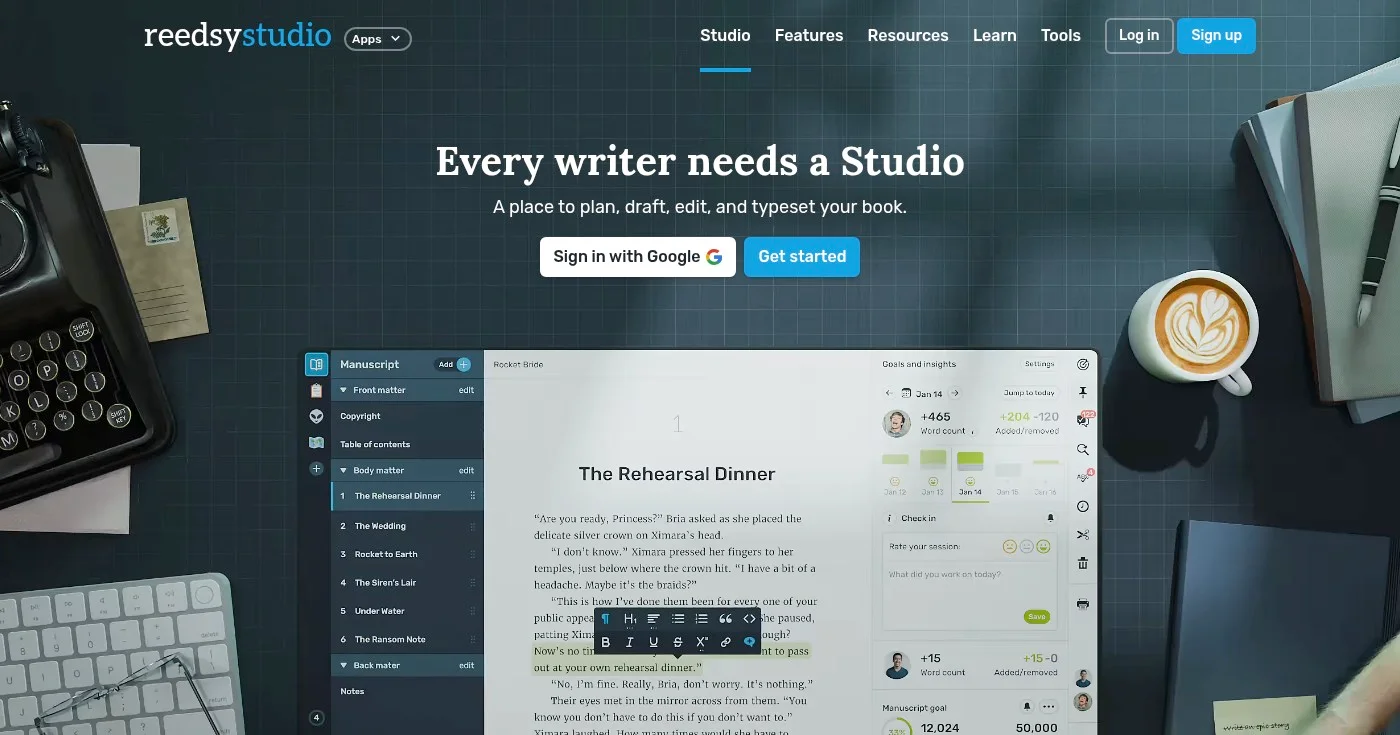
Reedsy Studio is a strong starting point for fiction and memoir writers. The goal-tracking feature lets you set daily word count targets and view a calendar of completed sessions, which builds a concrete record of progress against the inner critic's claims of failure.
For a broader overview of writing tools organized by function, see bestwriting.com/writing-tools.
Mislabeling writing anxiety as writer's block leads to the wrong treatment: waiting for inspiration to return. Anxiety doesn't resolve through waiting. It tends to deepen.
If you're avoiding the page because of fear or self-doubt (not because you genuinely lack ideas), naming it accurately matters. The block is a symptom. The anxiety is the cause.
Running your inner critic at full power during drafting is how perfectionism kills momentum. Every deleted sentence resets the psychological cost of starting. The edit mode and the generate mode need to be separated in time.
Draft first. Edit later. The sequence is not optional.
Comparing your first draft to a published, edited, revised book is a false equivalence. The author whose prose you admire went through the same uncertainty at the same stage you're in now. You're comparing your raw beginning to their polished output.
That comparison is not a measurement of ability. It's a measurement of timeline.
Vague project timelines allow writing anxiety to expand without limit. When the project is "due whenever," the psychological cost of postponement is always low enough to justify another delay. Hard deadlines (even self-imposed ones, shared with an accountability partner) create a boundary that anxiety cannot simply wait past.
Isolation reinforces self-doubt because there's no external data to correct it. Writing groups, beta readers, and writing center consultations provide reality-testing for the inner critic's claims. If your work consistently earns thoughtful engagement from other readers, the inner critic's certainty that it's terrible becomes harder to maintain.
"I can't write" and "I can't write this well yet" are fundamentally different statements. Writing anxiety often collapses the distinction. Current skill level in an unfamiliar format is a snapshot.
It changes with practice. The permanence assumption is one of anxiety's most durable distortions.

Spot passive voice with the be-plus-participle test. Keep it for unknown actors, then rewrite only when the missing agent is the point of the sentence.

Epistolary fiction is told through letters, diaries, and found documents. Nested origins, seven examples, and where the form breaks.

Free verse is open-form poetry with no prescribed meter or rhyme scheme. The line, cadence, and sound do the work meter used to do.
Professional publishing supported by generous companies you should check out.


